As manufacturing industries continue moving toward intelligent automation, companies require motion systems that provide high accuracy, fast response, and flexible integration. A 3-Axis Linear Unit Gantry is one of the most widely adopted automation solutions for applications requiring precise movement in X, Y, and Z directions.
Unlike traditional manual handling or complex robotic systems, a 3-axis linear gantry system uses coordinated linear motion modules to achieve accurate positioning across three axes. It is widely used in pick and place, assembly, dispensing, inspection, loading, and material handling applications.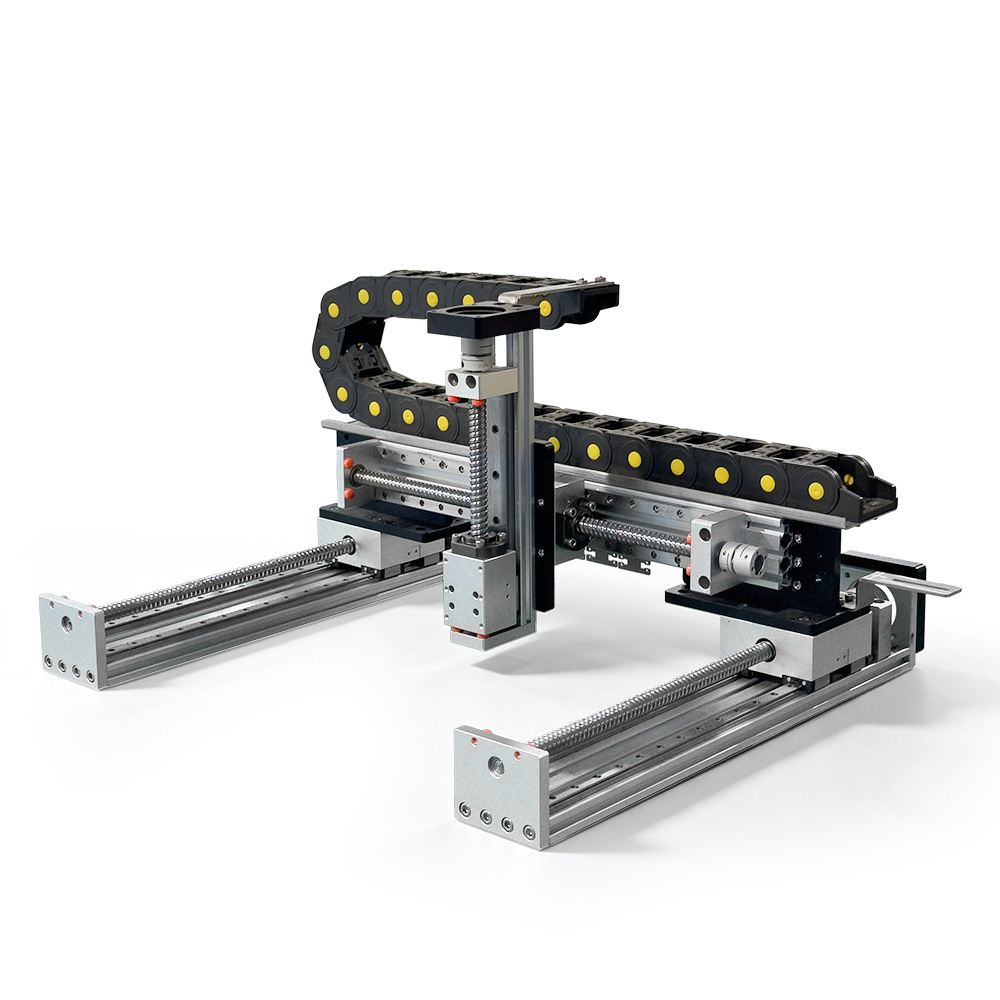
For OEM machine builders, automation integrators, and industrial manufacturers, a custom 3-Axis Linear Unit Gantry provides an efficient way to develop reliable and scalable automation equipment based on specific production requirements.
A 3-Axis Linear Unit Gantry is a Cartesian motion system consisting of three linear movement axes:
By combining multiple linear units, the gantry system can move tools or products accurately within a three-dimensional working area.
A typical 3-axis linear gantry includes:
The modular structure allows engineers to customize travel distance, payload capacity, speed, and accuracy according to application needs.
A 3-Axis Linear Unit Gantry converts motor rotation into precise linear movement through different drive technologies, including:
The controller coordinates movement between the three axes to achieve programmed positioning.
A typical working process includes:
This coordinated movement enables high-speed and repeatable automation.
Precision linear modules and advanced motion control provide excellent repeatability.
Advantages include:
For precision manufacturing, accurate positioning directly affects product quality.
Compared with traditional robotic arms, 3-axis gantry systems can easily cover larger working spaces.
Benefits include:
This makes them suitable for both compact machines and large production lines.
Every automation project has different requirements.
A custom 3-Axis Linear Unit Gantry can be designed according to:
Customized X, Y, and Z travel ranges.
Designed for different product weights and tooling requirements.
Configured for high-speed or high-precision applications.
Selection of:
Integration with:
Customization ensures the gantry system matches the production process.
Compared with multi-joint robotic systems, Cartesian gantry robots have simpler mechanical structures.
Advantages include:
This makes them a practical choice for many industrial applications.
3-Axis Linear Unit Gantry systems can work together with:
This allows manufacturers to create complete automated production solutions.
One of the most common applications includes:
High repeatability improves production efficiency.
Used for:
The system ensures consistent assembly quality.
3-axis gantry systems provide accurate movement for:
Programmable motion paths improve process consistency.
Applications include:
Automation reduces labor requirements and increases machine utilization.
Combined with cameras, gantry systems enable:
Precise positioning improves inspection accuracy.
Applications:
Applications:
Applications:
Applications:
Applications:
| Feature | 3-Axis Linear Unit Gantry | Industrial Robot Arm |
|---|---|---|
| Motion Type | Linear XYZ | Multi-axis rotation |
| Positioning Accuracy | Excellent | High |
| Programming Difficulty | Simple | More Complex |
| Working Area | Large | Moderate |
| Maintenance | Lower | Higher |
| Cost Efficiency | High | Moderate |
For applications requiring repetitive linear movement, a 3-axis gantry system is often a more efficient and economical solution.
Standard products may not always satisfy specialized automation requirements.
Custom gantry solutions can be developed based on:
Including:
Including:
Including:
A customized design ensures better performance and longer service life.
Before choosing a supplier, consider:
The manufacturer should understand:
A reliable supplier should provide:
Important factors include:
Professional suppliers should provide:
Modern gantry systems are becoming smarter through:
These improvements help manufacturers achieve higher productivity and smarter production management.
An experienced manufacturer can provide complete automation solutions, including:
This ensures the gantry system meets specific production goals.
A 3-Axis Linear Unit Gantry is a reliable and flexible automation solution for manufacturers requiring accurate three-dimensional movement. With advantages including high precision, large working areas, simple maintenance, and flexible customization, it is widely used in modern industrial automation.
For OEM customers and automation integrators, a custom 3-axis linear gantry system provides an effective way to improve production efficiency, reduce labor costs, and build scalable automation equipment.
Partnering with an experienced gantry robot manufacturer helps ensure the final system is optimized for your application and delivers reliable long-term performance.