A circular conveyor is a conveying system designed to move products, workpieces, pallets, or carriers along a circular or closed-loop path.
Compared with a conventional straight conveyor, a circular conveyor allows products to circulate through multiple stations within a continuous loop. This makes it particularly useful for automated production systems that require repeated transportation, processing, inspection, or assembly.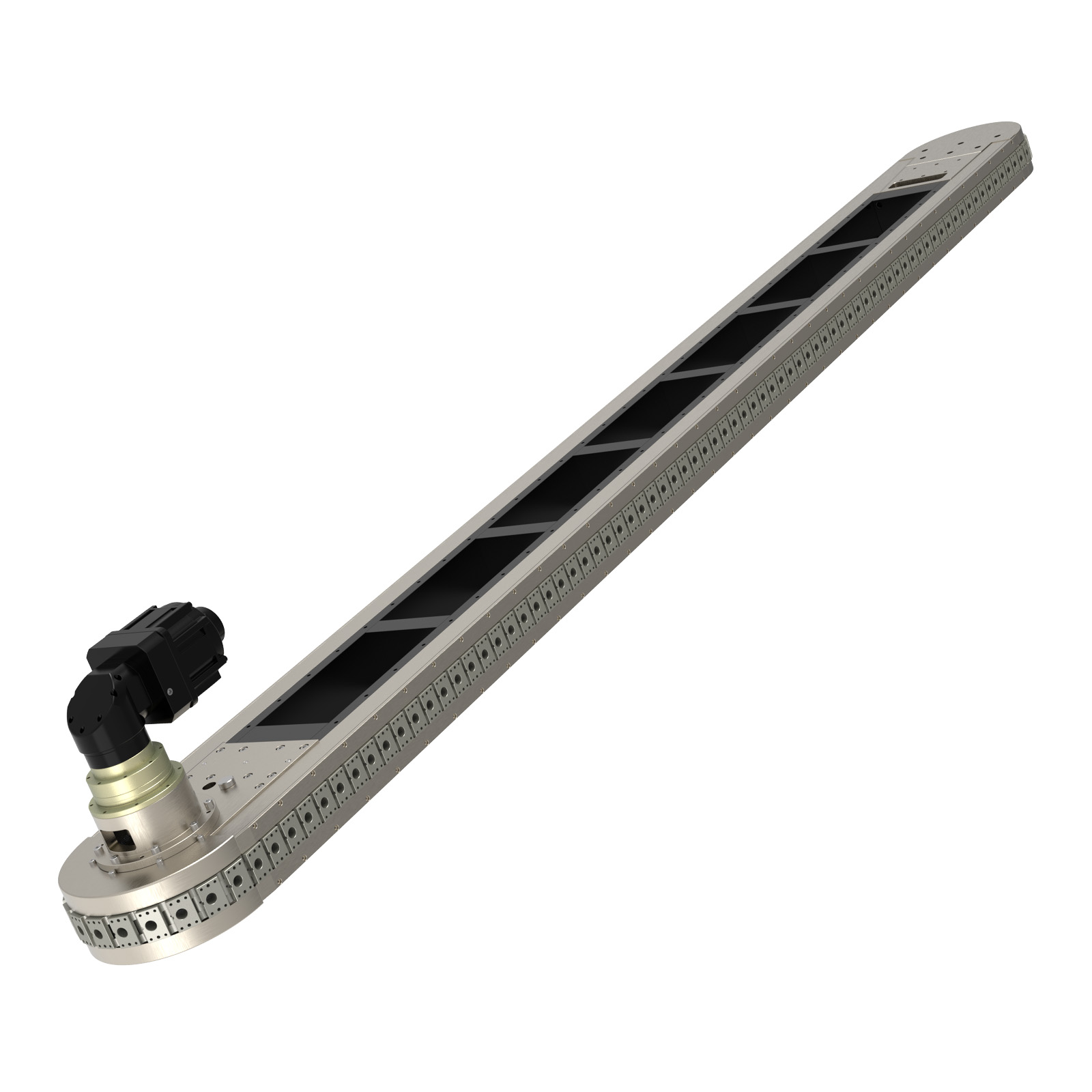
For OEM equipment manufacturers and automation integrators, the circular conveyor can be customized according to the product size, payload, production cycle, number of stations, layout, and positioning requirements.
A well-designed circular conveyor is therefore not simply a transportation device. It can become an important part of a complete automated production system.
One of the main characteristics of a circular conveyor is its closed-loop configuration.
Products or workpiece carriers can continuously circulate around the system rather than moving only in one direction along a straight line.
This configuration is useful when:
The closed-loop design can simplify the overall material flow in certain automation applications.
Circular conveyors are particularly suitable for production equipment with multiple processing stations.
A typical system may be arranged as:
Loading → Assembly → Inspection → Testing → Processing → Unloading → Return
Each station can perform a different operation while the conveyor moves workpieces between stations.
This makes circular conveyor systems suitable for automated assembly lines, inspection equipment, testing machines, and other multi-process production systems.
A circular conveyor can arrange several processing stations around a relatively compact conveying path.
Instead of extending the production line in one long straight direction, the system can make use of the space around the conveyor.
This can be valuable for equipment manufacturers working with limited factory or machine space.
The actual layout can be designed according to:
Different automation projects have different mechanical requirements.
A custom circular conveyor system can be developed according to the customer's machine dimensions and production process.
Typical customization parameters include:
For OEM customers, customized dimensions can make it easier to integrate the conveyor into an existing machine design.
Many industrial applications require products to remain in a controlled position during transportation.
A circular conveyor can therefore be equipped with customized carriers, pallets, tooling plates, or fixtures.
Custom carriers can be useful for:
The carrier design can be matched to the customer's workpiece so that transportation and processing can be coordinated more effectively.
Circular conveying systems can be designed for applications where workpieces need to reach defined processing positions.
Depending on the machine requirements, positioning may involve:
The required positioning performance depends on the complete system design, including the conveyor mechanism, drive system, carrier, load, acceleration, and positioning method.
A circular conveyor can work together with various types of automation equipment.
For example:
Circular Conveyor + Robot + Vision System + Assembly Unit + Inspection Station
This type of integration allows the conveyor to act as the transportation platform for an automated production cell.
It can also be combined with linear modules, electric cylinders, pick-and-place units, robotic arms, and other motion systems.
| Feature | Circular Conveyor | Straight Conveyor |
|---|---|---|
| Closed-loop circulation | Excellent | Limited |
| Multi-station layout | Excellent | Good |
| Product return | Easy within loop | Requires additional transfer |
| Space utilization | Flexible | Depends on layout |
| Continuous circulation | Excellent | Good |
| Automated assembly | Excellent | Excellent |
| Custom carriers | Available | Available |
| OEM customization | High | High |
| Long-distance transport | Application dependent | Excellent |
The best configuration depends on the production process, available space, payload, speed, positioning requirements, and number of processing stations.
Circular conveyors are well suited to automated assembly machines where a product needs to pass through several operations.
For example:
Loading → Component Feeding → Assembly → Fastening → Inspection → Unloading
A workpiece can remain on its carrier while moving between different stations.
This reduces the need for separate transportation mechanisms between each process.
Electronic components and assemblies often require multiple automated processes within a compact production system.
Circular conveyors can be integrated with:
Custom carriers can help maintain consistent product orientation during automated processing.
Automotive components often involve multiple assembly, inspection, and testing processes.
A circular conveyor can be used to transport components through different stations for:
For OEM production equipment, the conveyor dimensions and carrier design can be adapted to the customer's specific components.
Inspection equipment often requires products to arrive at a defined position before measurements or testing begin.
Circular conveyors can be integrated with:
A closed-loop arrangement can allow multiple inspection or testing stations to share the same conveying system.
Circular conveyors can provide a continuous supply of workpieces to robotic handling stations.
For example:
Circular Conveyor → Positioning Station → Robot Pick → Processing → Inspection → Return
This type of arrangement is useful for automated handling and assembly applications where robots repeatedly interact with workpieces.
Packaging production lines can require multiple operations within a limited machine footprint.
Circular conveyors may be considered for applications involving:
The actual conveyor configuration should be selected according to the product characteristics and required cycle time.
Circular conveyor systems are particularly valuable for special-purpose machinery where a standard conveyor cannot easily match the machine layout.
Potential applications include:
For custom projects, selecting a circular conveyor should begin with the customer's production process rather than a standard conveyor model.
A manufacturer can evaluate several important parameters.
The workpiece dimensions and weight determine the required carrier and conveying structure.
The required cycle time affects conveyor speed, indexing frequency, and station arrangement.
The number and function of processing stations determine the required conveyor layout and carrier spacing.
If robots, inspection cameras, or assembly equipment need to interact with the workpiece at specific positions, the positioning method should be considered during system design.
The circular conveyor can be designed around the available machine footprint and operator access requirements.
Custom carriers or fixtures may be required to securely hold and orient the product.
A standard conveyor may be suitable for basic transportation, but complex automation equipment often requires a more application-specific design.
A custom circular conveyor can be developed around the customer's:
For OEM customers, this approach can make the conveyor easier to integrate into the overall machine and production system.
Before requesting a quotation, customers can provide the following information:
Drawings, product samples, 3D models, or basic machine-layout information can also help the manufacturer evaluate the appropriate conveyor structure.