Circular and curved motion systems are increasingly used in automated production lines where products need to move through multiple workstations within a compact layout. In these applications, the guide rail is not simply a supporting component. It plays an important role in controlling carrier movement, maintaining stability, and supporting consistent operation.
Choosing the right Circular Guide Rail Manufacturer is therefore important for OEM machine builders and automation integrators developing customized conveyor and motion systems.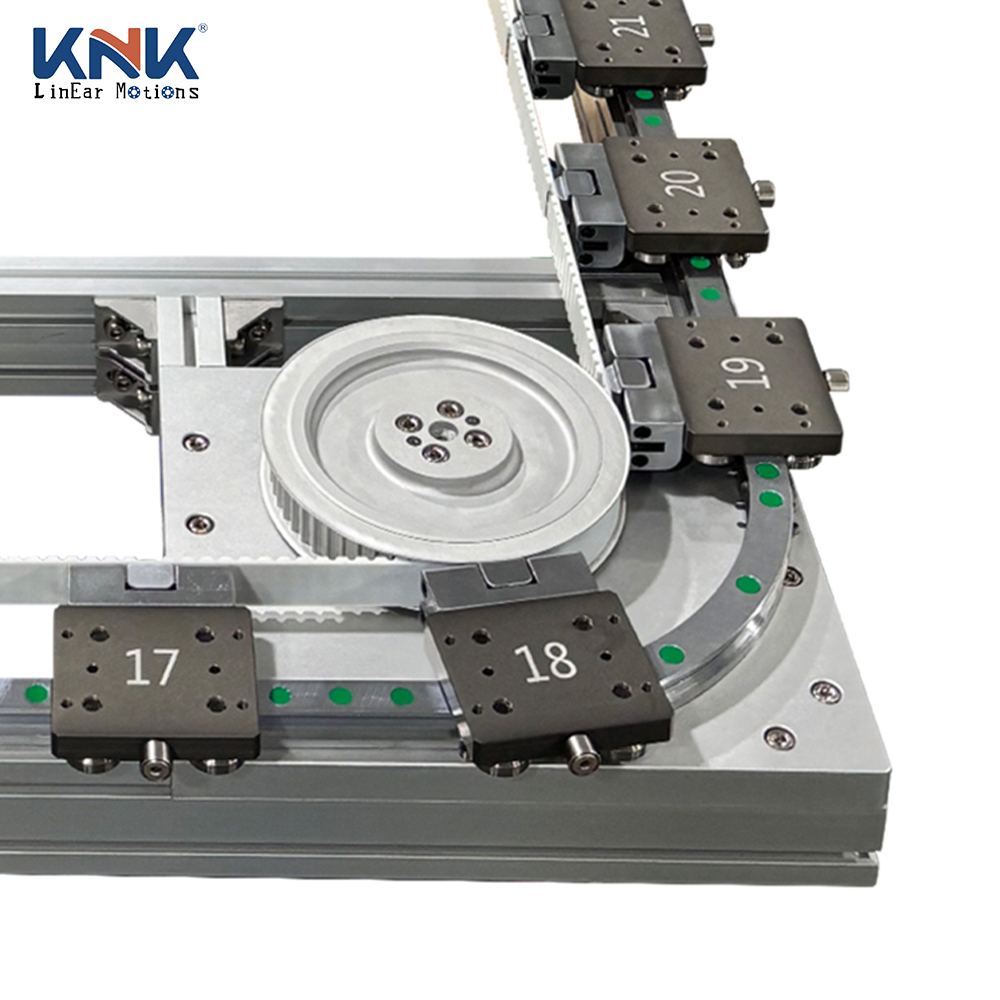
A professional manufacturer can design the guide rail according to the required track shape, radius, dimensions, carrier load, speed, positioning requirements, installation space, and production process.
A circular guide rail is a mechanical guiding system designed to control the movement of carriers, sliders, pallets, or other moving components along a curved or closed-loop path.
Depending on the application, the guide system can be designed as:
The guide rail works together with components such as carriers, rollers, bearings, chains, belts, or drive mechanisms to create a controlled motion path.
In a circular conveyor or curved motion system, the guide rail directly influences how the carrier moves through the track.
A well-designed guide rail should help provide:
The actual performance depends on the complete system, including the guide rail, carrier, drive mechanism, bearings, frame, load, and installation accuracy.
For this reason, selecting a custom circular guide rail manufacturer with application engineering capabilities can be more valuable than simply purchasing a standard rail.
OEM automation equipment often has unique dimensions and process requirements.
A standard guide rail may not match the machine's:
A custom circular guide rail system can be designed around the customer's machine.
Customization may include:
Precision is particularly important when a circular guide rail is used with automated assembly or inspection equipment.
A carrier may need to move to a predefined workstation and maintain a consistent position before an automated operation begins.
Potential applications include:
For these applications, the guide rail should be evaluated together with the carrier and positioning mechanism.
One common application is the circular conveyor guide rail.
A circular or elliptical conveyor can use a guided track to move carriers through multiple stations.
A typical process may be:
Loading → Assembly → Inspection → Testing → Unloading → Return
The guide rail controls the carrier path while the conveyor drive provides the movement.
Depending on the application, the conveyor can use:
The guide rail and drive system should be selected as a complete mechanical system.
A conventional linear guide rail is designed primarily for straight-line movement. A circular guide rail is designed to accommodate curved or continuous paths.
| Feature | Circular Guide Rail | Linear Guide Rail |
|---|---|---|
| Movement | Circular / Curved | Linear |
| Track Layout | Closed loop or curved | Straight |
| Carrier Circulation | Possible | Usually no |
| Multi-Station Layout | Excellent | Application dependent |
| Custom Geometry | High | Usually straight |
| Conveyor Integration | Excellent | Good |
| Typical Application | Circular conveyor, indexing systems | Linear motion systems |
The appropriate guide technology depends on the required movement path and machine architecture.
An elliptical conveyor combines straight and curved sections to form a continuous loop.
The guide rail helps maintain the carrier's path as it transitions between:
Straight Section → Curve → Straight Section → Curve
This configuration can provide several advantages for automated production:
For OEM customers, the elliptical track can be designed according to available factory space and production requirements.
A customized guide rail system can support multiple processing stations around the same track.
For example:
Product loading
Component assembly
Fastening or dispensing
Vision inspection
Functional testing
Product unloading
The carrier can circulate between the stations while the automated equipment performs a specific operation at each location.
This makes a precision circular guide rail system particularly suitable for repetitive multi-stage manufacturing.
The required load is one of the first parameters a Circular Guide Rail Manufacturer should evaluate.
The total moving load may include:
The load affects the selection of:
For higher-load applications, the guide system should be evaluated together with the supporting frame and drive mechanism.
The required operating speed also influences guide rail design.
High-speed applications may require attention to:
A system designed for slow precision assembly may have very different requirements from a high-speed product transfer line.
Therefore, customers should provide the required speed and cycle time when requesting a custom design.
A circular guide rail primarily provides guidance. It should not automatically be considered the sole source of high positioning accuracy.
For automated production, positioning may be achieved through a combination of:
If a product needs to be positioned accurately for assembly or inspection, the complete station design should be considered.
Circular guide rail systems can be integrated with robotic pick-and-place equipment.
A robot can be installed beside the track to:
The circular track provides a controlled route for the carriers, while the robot performs operations at predefined positions.
This configuration can be useful for electronics, automotive components, consumer products, and other automated manufacturing applications.
Inspection and testing systems often require products to reach predefined locations repeatedly.
A custom guide rail system can support the movement of carriers through:
Loading → Inspection → Measurement → Testing → Sorting → Unloading
Possible equipment includes:
The carrier and guide rail should be designed together when product orientation and positioning are important.
When choosing a Circular Guide Rail Manufacturer, OEM customers should evaluate the following capabilities.
The manufacturer should be able to work with customer drawings and application specifications.
Important parameters include:
The guide rail should be designed together with the carrier, roller, bearing, and supporting structure.
For circular conveyor applications, the manufacturer should understand how the guide system works with:
A good supplier should be able to support:
Before requesting a quotation for a custom circular guide rail, provide:
CAD drawings or sketches can also help the manufacturer understand the required system layout.
Custom circular guide rail systems can be used in many industries.
For simple applications, an off-the-shelf guide component may be sufficient.
For OEM automation projects, however, the guide rail often needs to match the complete machine architecture.
A custom manufacturer can help coordinate:
Track Geometry + Guide Rail + Carrier + Drive System + Positioning + Automation Equipment
This integrated approach can reduce compatibility problems during machine development.
Instead of selecting a standard guide rail first and modifying the machine afterward, OEM customers can define the required production process and develop the guide system around it.
A Circular Guide Rail Manufacturer plays an important role in developing customized curved and closed-loop motion systems for industrial automation.
A well-designed circular guide rail can provide controlled carrier movement for circular conveyors, elliptical conveyors, multi-station assembly systems, inspection equipment, testing machines, and automated material handling systems.
For OEM customers, customization can cover track geometry, radius, dimensions, carrier configuration, payload, speed, positioning requirements, and installation conditions.
The best solution is not necessarily the most complex guide rail. It is the one that matches the application's actual load, speed, accuracy, cycle time, and machine layout.
For this reason, OEM machine builders and automation integrators should work with a custom Circular Guide Rail Manufacturer that can provide both mechanical design and application-specific support.