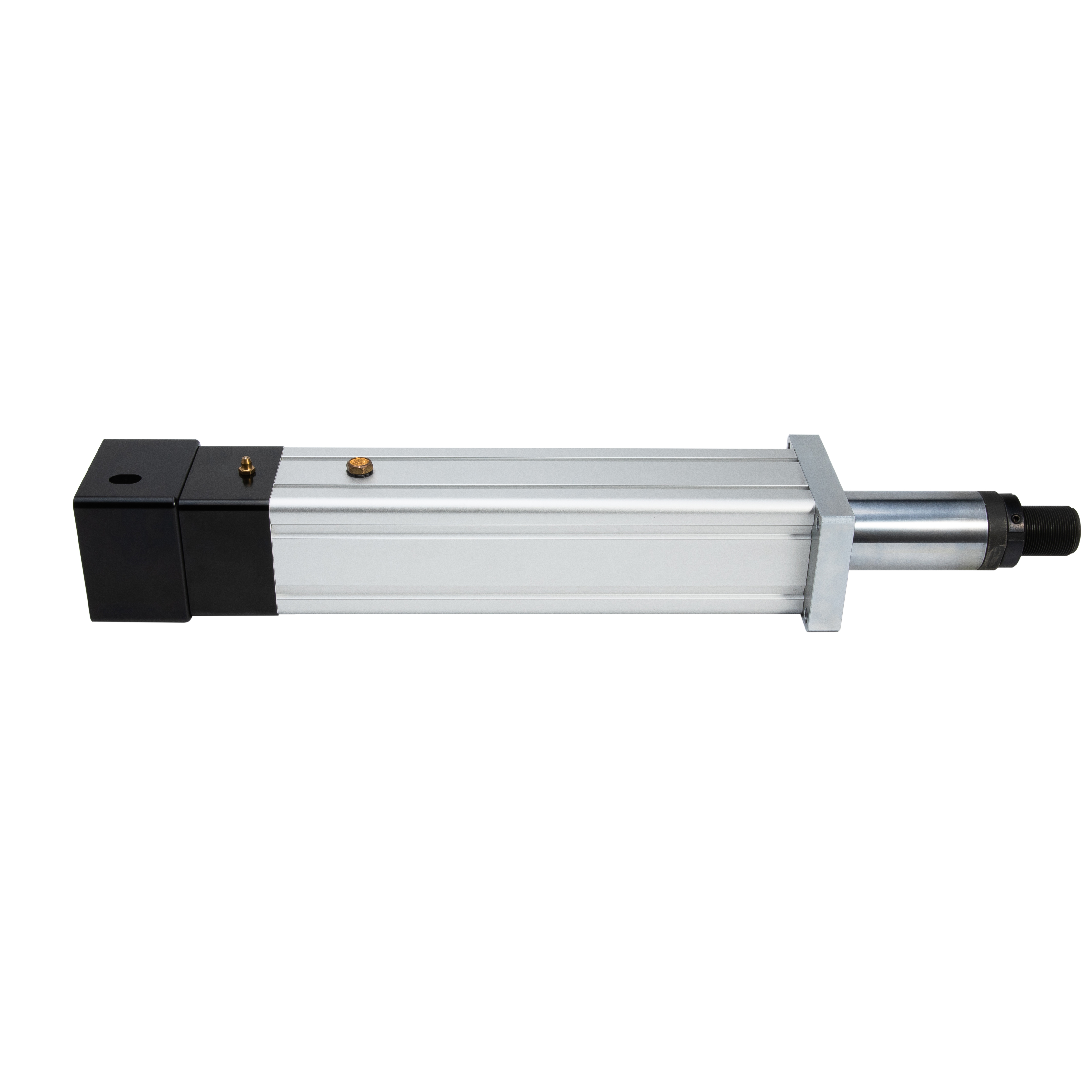
Linear cylinders are linear motion devices designed to generate controlled movement along a straight axis. They are commonly used for pushing, pulling, lifting, positioning, clamping, feeding, and transferring components in automated machinery.
Depending on the required application, linear cylinders can be designed with different drive mechanisms, motors, strokes, loads, speeds, and control configurations.
For modern automation equipment, electric linear cylinders are particularly useful when the application requires programmable motion, adjustable speed, repeatable positioning, or integration with PLC and servo control systems.
For OEM equipment manufacturers, a standard cylinder may not always match the machine design. A custom linear cylinder can be configured around the required stroke, payload, installation dimensions, speed, positioning requirements, and working environment.
The primary function of a linear cylinder is to convert rotary or electrical energy into linear movement.
Depending on the design, the cylinder can perform:
This makes linear cylinders suitable for many repetitive machine operations.
For automated equipment, the motion can be coordinated with sensors, PLCs, servo drives, or other automation components.
Stroke is one of the most important parameters when selecting a linear cylinder actuator.
Different machines may require completely different travel distances.
A custom cylinder can be designed according to the required stroke, for example:
Custom stroke lengths can help OEM customers optimize the cylinder for their machine rather than redesigning the machine around a standard component.
Different automation processes require different movement speeds.
A fast pick-and-place mechanism may require rapid movement, while a pressing or positioning operation may need slower and more controlled motion.
For an electric linear cylinder, motion parameters can be selected according to:
The actual achievable performance depends on the motor, transmission, load, stroke, control system, and operating conditions.
Compared with basic pneumatic cylinders, electric linear cylinders can provide more flexible control over motion.
Depending on the system configuration, programmable positioning can allow the cylinder to:
This makes electric cylinders suitable for machines where the movement needs to change according to the production process.
A linear cylinder can provide powered linear movement within a relatively compact mechanical structure.
This can be useful when installation space is limited.
OEM customers may customize:
The final configuration can therefore be adapted to the available space inside the machine.
Linear cylinders can be designed for different payload and force requirements.
The required force depends on several factors, including:
For vertical applications, gravity must also be considered when calculating the required force and motor capacity.
A professional linear cylinder manufacturer should evaluate these parameters before recommending the appropriate actuator configuration.
Modern linear cylinder actuators can be integrated with various control and automation components.
Typical system components include:
This allows a linear cylinder to operate as part of a larger automated machine instead of functioning as an isolated mechanical component.
For OEM applications, the choice between electric and pneumatic motion depends on the required machine performance.
| Feature | Electric Linear Cylinder | Pneumatic Cylinder |
|---|---|---|
| Motion control | Highly programmable | Generally simpler |
| Positioning | Suitable for controlled positioning | Usually requires additional components |
| Speed control | Programmable | Adjustable with pneumatic controls |
| Multiple positions | Easy to program | More complex |
| Air supply | Not required | Required |
| PLC integration | Excellent | Excellent with suitable controls |
| Energy system | Electrical | Compressed air |
| Custom motion profiles | Possible | More limited |
For applications requiring programmable positioning and flexible motion profiles, an electric linear cylinder can offer significant advantages.
Linear cylinders can perform repetitive movement during automated assembly.
Typical operations include:
For example, an electric cylinder can move a component into a defined assembly position before another actuator or robot performs the next operation.
Linear cylinders can provide one or more axes of movement for pick-and-place machinery.
A typical system may combine:
Linear Cylinder + Gripper + Sensor + PLC
The cylinder moves the gripper to the required position, while the control system coordinates the complete sequence.
For high-cycle applications, stroke, acceleration, payload, and cycle time should be evaluated together.
Vertical linear cylinders can be used for lifting or height adjustment.
Applications include:
For vertical applications, the cylinder must be properly sized for the payload and gravitational load.
A linear cylinder can provide controlled movement for clamping mechanisms.
Typical applications include:
The required cylinder force and mechanical structure should be selected according to the clamping load.
Linear cylinders can move products or components between predefined positions.
They can be used in:
When integrated with sensors and conveyors, the cylinder can become part of a complete automated material handling process.
Packaging equipment often requires repetitive pushing, positioning, and feeding movements.
Linear cylinders can be used for:
Electric cylinders can be useful when different products require different motion parameters.
A linear cylinder can move a sensor, camera, probe, or workpiece into a defined inspection position.
Applications include:
When combined with an encoder or other feedback device, the motion system can support repeatable positioning.
For custom automation projects, the most important advantage of working with a custom linear cylinder manufacturer is the ability to match the actuator to the machine.
Typical customization requirements include:
Before selecting a linear cylinder, OEM engineers should define several key parameters.
Determine the actual distance the cylinder needs to travel.
Avoid selecting a stroke significantly longer than necessary if installation space is limited.
Calculate the total moving load and external resistance.
For vertical applications, include gravity in the calculation.
Determine the required travel speed and machine cycle time.
Consider whether the application needs:
Check:
Consider dust, temperature, moisture, oil, cleanliness, and operating frequency when selecting the actuator structure and components.
For standard applications, an off-the-shelf actuator may be sufficient.
However, OEM automation equipment often has unique requirements.
A custom linear cylinder manufacturer can help optimize the actuator around the complete machine design.
Instead of simply selecting a cylinder from a catalog, the manufacturer can evaluate:
Load → Stroke → Speed → Accuracy → Cycle Time → Installation → Motor → Control
This application-oriented approach can help improve mechanical integration and reduce unnecessary oversizing or redesign.
For automation equipment manufacturers, this is especially valuable when the cylinder will be integrated into a larger system containing linear modules, conveyors, robots, sensors, and PLC controls.