Modern manufacturing lines often require more than simple linear transportation. When products need to circulate continuously between multiple workstations, an Oval Belt Loop Track Conveyor System can provide a flexible solution for automated production.
Unlike a conventional straight belt conveyor, an oval belt loop conveyor creates a continuous closed-loop path. Products, pallets, fixtures, or workpieces can circulate through different processing stations and return to the starting point without requiring a separate return conveyor.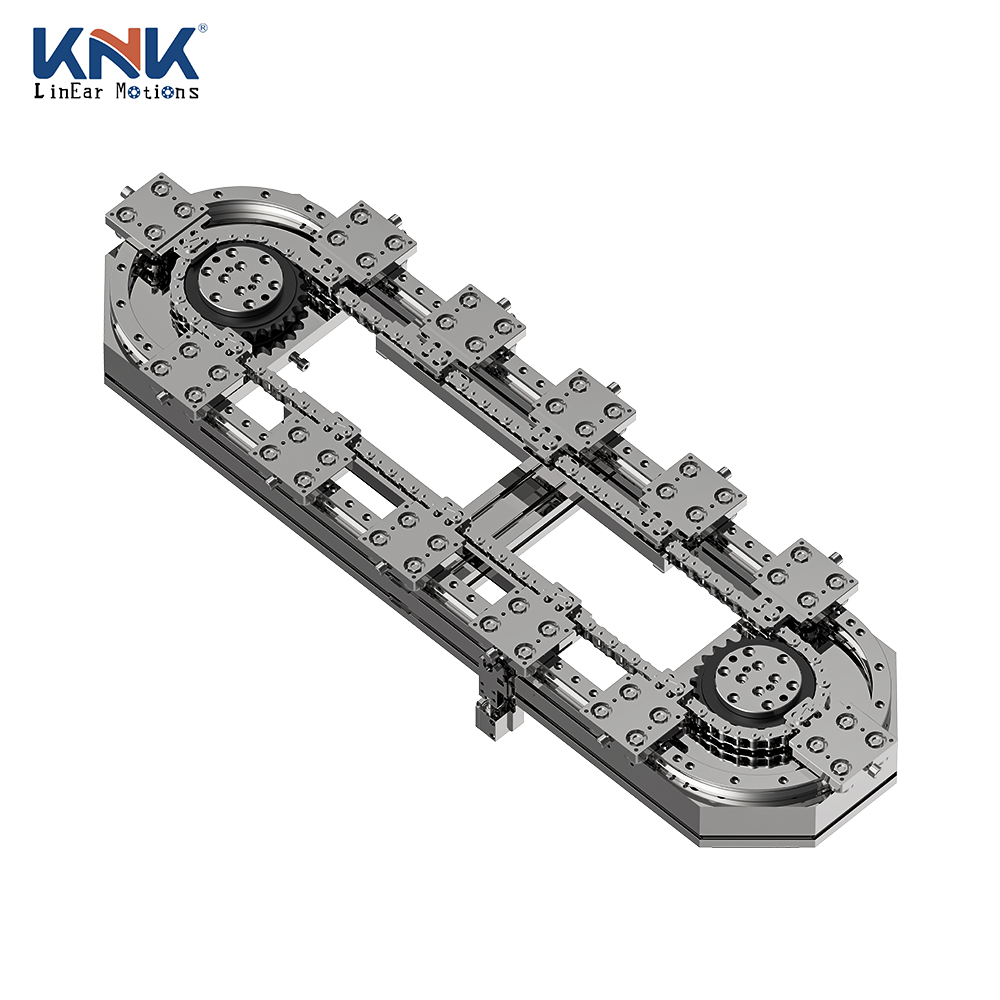
For OEM machine builders and automation integrators, the system can be customized according to track dimensions, belt length, payload, speed, carrier configuration, workstation spacing, installation height, and positioning requirements.
An Oval Belt Loop Track Conveyor System is a continuous conveyor configuration consisting of straight sections and curved sections that form an oval or closed-loop track.
A typical system may include:
The belt continuously circulates around the track, carrying products through different stations.
A simplified production flow is:
Loading → Assembly → Inspection → Testing → Processing → Unloading → Return
This makes the oval conveyor suitable for production environments where products need to repeatedly circulate through a defined process.
The working principle is similar to a conventional belt conveyor, but the belt follows a closed-loop path.
The motor drives the pulley, which moves the belt along the track. The belt then passes through the straight and curved sections before returning to the drive area.
The basic motion sequence is:
Motor → Drive Pulley → Belt Movement → Product Transfer → Return Section
Depending on the application, products can be transported continuously or stopped at specific workstations.
Sensors and control systems can be integrated to coordinate conveyor movement with automated equipment.
Standard conveyors are often designed for straightforward transportation. OEM production lines may require a more specialized configuration.
A custom oval belt conveyor system can be designed according to the actual machine layout and production process.
Common customization parameters include:
This makes the system suitable for specialized automation projects.
The oval configuration allows products to circulate continuously.
This can simplify production flow by connecting several stations within a single conveyor system.
For example:
Station A → Station B → Station C → Station D → Station A
Products can return to the starting point after completing the production cycle.
An oval conveyor can place multiple processing stations around a single loop.
Compared with several independent straight conveyors, this configuration may help organize:
The final layout should be designed according to available factory space and process requirements.
One oval conveyor can support several automated operations.
Possible stations include:
This makes an oval belt loop conveyor useful for multi-stage manufacturing.
Products can remain on the same carrier while passing through multiple stations.
This can reduce repeated manual transfers and help maintain a consistent product orientation.
For applications requiring controlled product movement, customized carriers or fixtures can be integrated into the conveyor.
An oval conveyor system can be used as the transportation platform for automated assembly.
A typical workflow may be:
Product Loading → Component Placement → Assembly → Inspection → Testing → Unloading
Each workstation can be positioned alongside the straight sections of the conveyor.
Robotic systems can then interact with products as they reach the corresponding station.
Possible integrated equipment includes:
Inspection processes often require products to pass through several checkpoints.
A customized oval conveyor can connect:
Cameras and sensors can be positioned around the track.
For applications requiring accurate inspection positioning, additional positioning mechanisms can be integrated into the conveyor.
An oval belt loop conveyor can work together with automated pick-and-place systems.
A robot can be positioned alongside the conveyor to:
The closed-loop track provides continuous product circulation while robots perform specific operations at selected stations.
The belt and carrier design should match the product being transported.
Depending on the application, the system can be designed around:
Small components and large workpieces require different belt and carrier configurations.
The total payload affects belt selection, drive capacity, frame design, and motor sizing.
Custom fixtures can help maintain consistent product orientation during transportation.
The distance between products can be customized according to workstation requirements.
For precision automation, the carrier design can be particularly important because the carrier becomes the interface between the conveyor and the production equipment.
The required conveyor speed depends on the production process.
Important parameters include:
A continuous transportation process may use a relatively high belt speed, while an assembly or inspection system may require slower movement and controlled stops.
The conveyor should therefore be designed based on cycle time rather than maximum belt speed alone.
A standard belt conveyor primarily focuses on product transportation. However, automation applications may require products to stop at repeatable positions.
For these applications, the system can incorporate:
The actual positioning performance depends on the complete conveyor structure, belt system, carrier, drive system, and positioning mechanism.
| Feature | Oval Belt Loop Conveyor | Straight Belt Conveyor |
|---|---|---|
| Track Layout | Closed loop | Straight |
| Product Circulation | Yes | Usually one direction |
| Multiple Workstations | Excellent | Good |
| Return Path | Integrated | Usually requires separate path |
| Factory Layout Flexibility | High | Moderate |
| Automated Assembly | Excellent | Good |
| Custom Carrier Integration | Yes | Yes |
| Continuous Loop Operation | Yes | Limited |
A straight belt conveyor is often appropriate for basic material transportation. An oval belt loop conveyor system is more suitable when products need to circulate between multiple workstations.
OEM customers often have unique requirements that cannot be addressed by standard conveyor dimensions.
A customized system can be designed according to:
A complete custom oval conveyor system can integrate several automation technologies.
For example:
Oval Conveyor + Cartesian Robot + Vision System + Assembly Station + Testing Station
The conveyor handles product circulation while each automated module performs a dedicated operation.
This modular approach can make it easier to create customized production lines for different products.
When selecting an oval conveyor manufacturer, OEM customers should evaluate more than belt quality.
Important considerations include:
The supplier should understand:
The manufacturer should be able to customize:
The conveyor may need to integrate with:
A supplier capable of handling both conveyor mechanics and automation integration can simplify the development process.
Before requesting a quotation, it is useful to provide:
These parameters allow the manufacturer to evaluate the appropriate conveyor structure and drive system.
Custom oval conveyor systems can be used in:
An Oval Belt Loop Track Conveyor System provides a flexible solution for production lines that require continuous product circulation and multiple processing stations.
By combining straight and curved conveyor sections into a closed-loop configuration, the system can help connect assembly, inspection, testing, dispensing, packaging, and material handling stations within a single production layout.
For OEM machine builders and automation integrators, customization can cover track dimensions, belt width, carrier design, carrier pitch, payload, speed, motor configuration, positioning system, and workstation layout.
A properly designed oval conveyor should not be selected only according to belt speed or overall dimensions. The complete production process, including product weight, cycle time, workstation requirements, positioning needs, and automation integration, should be considered.
For specialized applications, working with an experienced custom oval conveyor manufacturer can help create a conveyor system that is matched to the customer's equipment and production requirements.