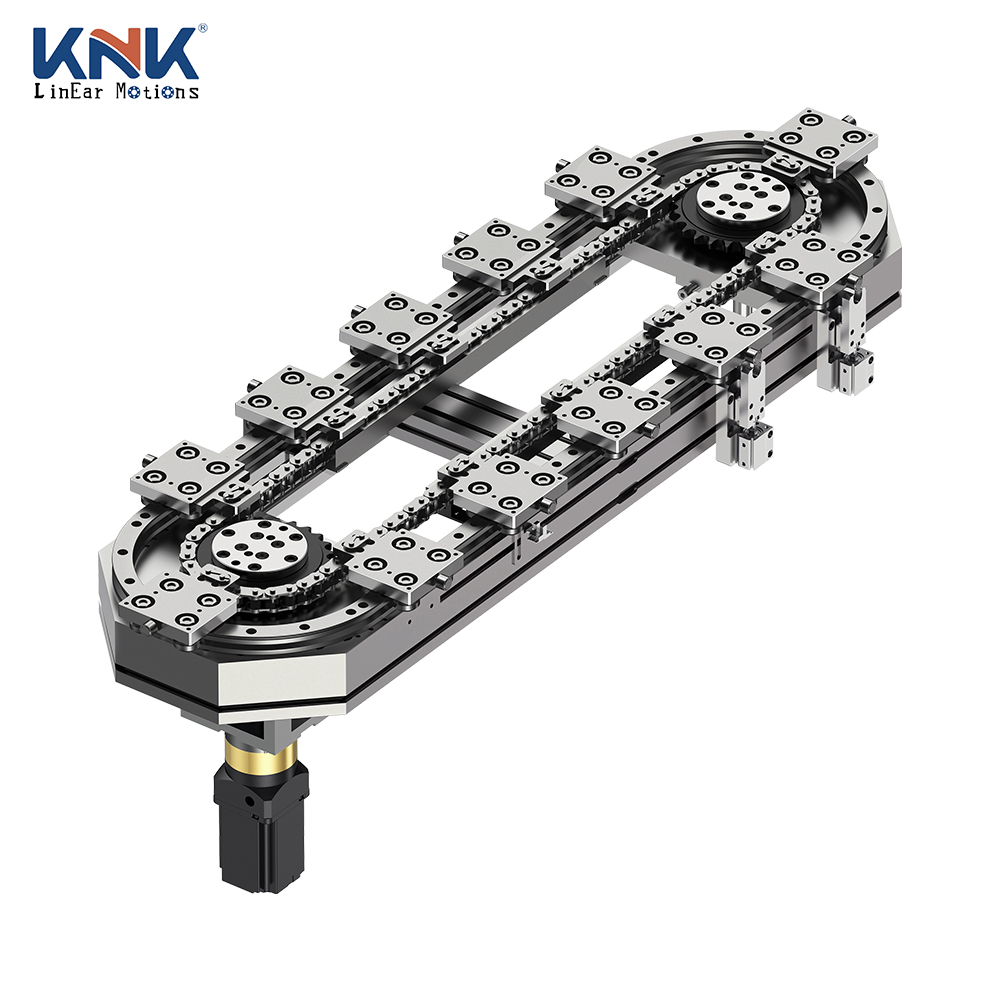
An oval conveyor track is a closed-loop material handling and positioning system that moves products, pallets, fixtures, or workpiece carriers along an oval or elliptical path. Unlike a traditional straight conveyor, an oval conveyor track creates a continuous circulation route that can connect multiple workstations within the same automated production system.
For OEM equipment manufacturers and automation integrators, a custom oval conveyor track can be designed according to the required layout, load, speed, positioning requirements, number of stations, and workpiece dimensions.
The system is particularly suitable for applications where products need to move repeatedly through multiple processes such as:
Loading → Assembly → Processing → Inspection → Testing → Unloading → Return
The closed-loop structure allows carriers to return automatically and continue circulating through the production process.
An oval track conveyor generally consists of a continuous closed-loop path with straight sections connected by curved sections.
Depending on the application, the system may include:
The oval configuration combines the advantages of long straight working sections with curved return sections.
This allows multiple stations to be positioned along the conveyor without requiring a separate return conveyor.
The most important feature of an oval conveyor track is its continuous loop configuration.
Products, pallets, or fixtures can travel through multiple stations and return to the starting point.
This makes the system suitable for:
Compared with a straight conveyor, the closed-loop design can simplify the return flow of empty carriers.
An oval conveyor layout can make better use of available floor space.
The long straight sections can accommodate multiple workstations, while the curved sections guide the carriers back to the opposite side of the production system.
The overall dimensions can be customized according to:
For custom automation equipment, the layout can be designed around the production process instead of adapting the process to a standard conveyor size.
A custom oval conveyor can be configured with different straight-section lengths.
The overall loop size may be adjusted according to the number of workstations and the distance required between them.
This provides flexibility for applications ranging from compact assembly cells to longer automated production systems.
For example, the system may include:
Station 1 → Station 2 → Station 3 → Station 4 → Station 5
Additional stations can be arranged along the straight sections when the process requires more operations.
One of the main advantages of an oval conveyor system is the ability to connect multiple automated processes.
A typical system may include:
Each operation can be positioned around the conveyor according to the production sequence.
This structure is particularly useful for customized automation lines where each workstation performs a specific process.
Many oval conveyor systems transport workpiece carriers instead of moving products directly.
A customized carrier can maintain the correct position and orientation of the product during transportation.
Carrier customization may consider:
For precision assembly or inspection, the carrier design can play an important role in maintaining consistent positioning between stations.
Different oval conveyor track applications may require different drive solutions.
The drive configuration can be selected according to:
Depending on the system design, the conveyor may use mechanical transmission, belt drive, chain drive, or other motion technologies.
For applications requiring accurate indexing, the drive and control system should be designed around the required stopping positions.
An oval conveyor can be integrated with different automation technologies.
These may include:
The conveyor acts as the transportation platform connecting multiple processes into one automated system.
| Feature | Straight Conveyor | Oval Conveyor Track |
|---|---|---|
| Material flow | One direction | Continuous loop |
| Carrier return | Separate system may be needed | Integrated return path |
| Multi-station layout | Limited | Highly flexible |
| Fixture circulation | More complex | Convenient |
| Space utilization | Depends on layout | Efficient closed-loop layout |
| Automation integration | Good | Excellent for multi-station systems |
A straight conveyor is suitable for simple point-to-point transportation.
An oval track conveyor is more suitable when workpieces or fixtures need to circulate continuously through multiple processing stations.
An oval conveyor track can connect multiple assembly operations.
For example:
Loading → Component Assembly → Fastening → Inspection → Testing → Unloading
Products or fixtures can continuously move through each stage of the production process.
This is suitable for electronics, automotive components, consumer products, and industrial equipment.
Electronics production often requires multiple processes and precise product positioning.
An oval conveyor system can transport workpiece carriers between:
The closed-loop configuration allows carriers to return to the starting position for the next production cycle.
An oval conveyor rail can transport products through several inspection stations.
Potential processes include:
The conveyor can stop or position the carrier according to the requirements of each inspection process.
Industrial robots can be positioned around the straight sections of an oval conveyor track.
Each robot can perform a different operation, such as:
The conveyor speed and carrier positioning can be coordinated with the robot cycle time.
Battery modules, electronic products, and precision components may require multiple manufacturing processes.
A custom oval conveyor can be configured with dedicated carriers to support:
The actual system configuration should be based on the product dimensions, weight, and production process.
For smaller products or samples, an oval conveyor track can connect different processing or inspection stations.
Potential applications include:
Special requirements such as cleanliness, materials, and environmental conditions can be considered during system design.
Standard conveyor systems may not match the requirements of specialized automation equipment.
A custom oval conveyor track can be designed according to the complete production process.
When developing a custom system, OEM customers should provide the following information.
Provide the:
Determine how many processing stations are required.
This affects the straight-section length and the overall conveyor layout.
The required output determines the conveyor speed and station cycle time.
Specify whether the conveyor requires:
Consider:
These factors can affect material and component selection.
For OEM projects, the conveyor is often part of a larger automation system.
The manufacturer should therefore understand not only conveyor transportation but also:
A suitable oval conveyor manufacturer can help develop the system from application requirements through mechanical design and production.
The goal is to create a system in which the conveyor, carrier, automation equipment, and production process work together.