In automated production, products are not always arranged at the same distance from each other. Different processes may require components to be spaced, compressed, expanded, or repositioned before assembly, inspection, packaging, or transfer.
A Variable Pitch Module provides a practical way to automatically change the distance between multiple carriers, grippers, fixtures, or products.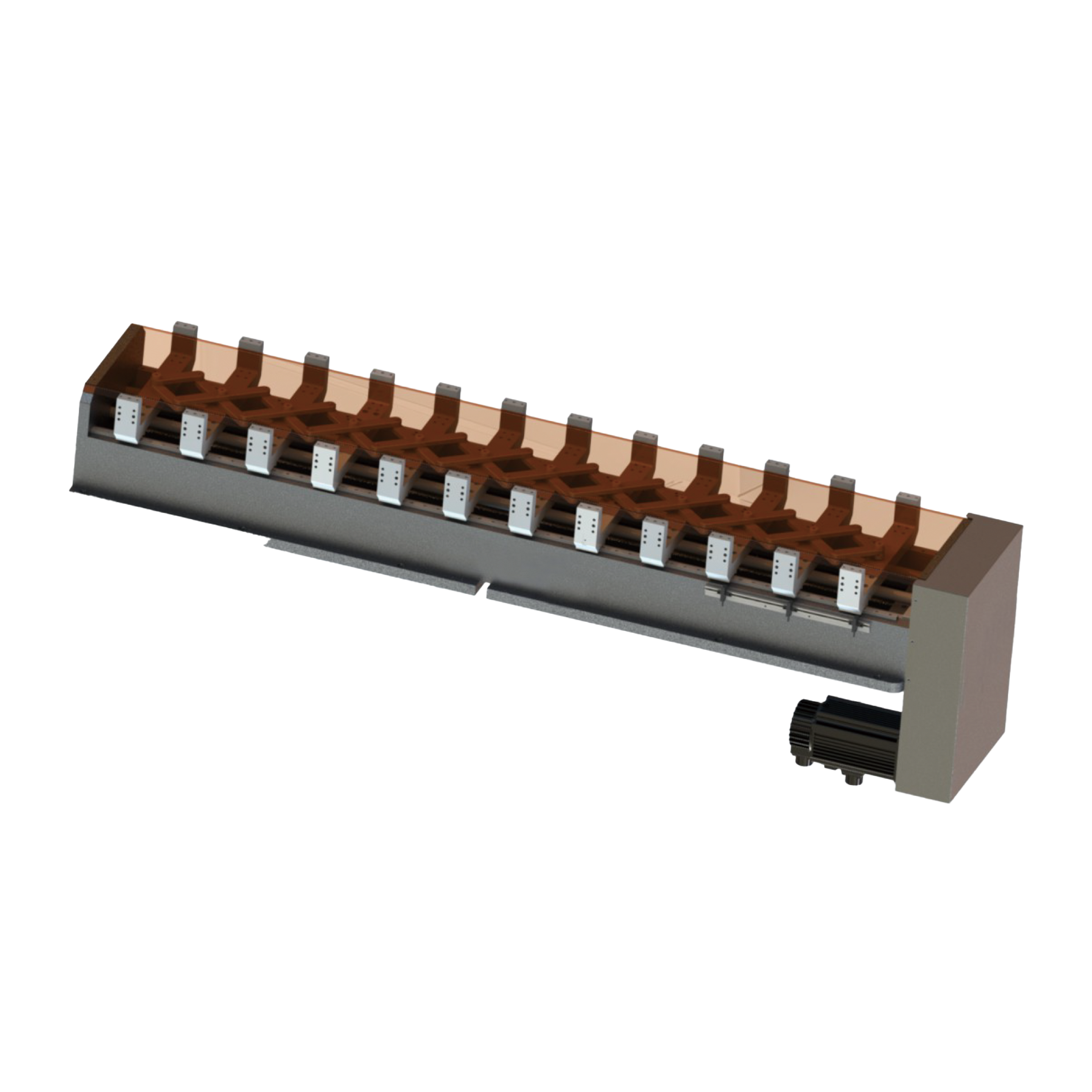
Unlike a conventional linear motion module that mainly moves a single carriage along a fixed axis, a variable pitch system is designed to control the relative spacing between multiple moving positions. This makes it useful for automation applications where product pitch needs to change during the production process.
For OEM machine builders and automation integrators, the module can be customized according to number of positions, pitch range, stroke, payload, speed, positioning requirements, installation space, and control method.
A Variable Pitch Module is a motion-control mechanism used to adjust the spacing between multiple products, carriers, fixtures, or tooling positions.
For example, products may enter a machine at:
20 mm pitch → 20 mm pitch → 20 mm pitch
and then need to be expanded to:
50 mm pitch → 50 mm pitch → 50 mm pitch
before entering another processing station.
The variable pitch module performs this spacing adjustment automatically.
Depending on the machine design, the system may use:
The specific mechanism should be selected according to the required pitch range, speed, load, and accuracy.
The primary function is to change the distance between multiple positions.
A customized system can be designed for applications requiring:
This allows one production line to handle different process requirements.
A variable pitch module can control several products or carriers simultaneously.
For example:
Input:
10 mm → 10 mm → 10 mm → 10 mm
Output:
30 mm → 30 mm → 30 mm → 30 mm
Multiple products can therefore be repositioned in one coordinated movement.
This can be particularly useful when several products need to enter a processing station simultaneously.
Different machines require different pitch ranges.
For OEM applications, the pitch can be designed according to the production process.
Common design parameters include:
A custom variable pitch module allows the spacing mechanism to be designed around the customer's actual machine requirements.
When multiple products need to change position simultaneously, synchronization becomes important.
A properly designed variable pitch mechanism can coordinate the movement of multiple carriers.
This can help reduce:
For automated production, synchronized pitch adjustment can improve process consistency.
A variable pitch module can be integrated into existing automation equipment.
It can be combined with:
The module can therefore function as a dedicated pitch adjustment unit within a larger automation system.
Fixed-pitch systems are suitable when products always maintain the same spacing.
However, many production processes require different spacing at different stages.
For example:
Feeding → Pitch Expansion → Assembly → Inspection → Pitch Reduction → Packaging
Without an automatic pitch adjustment mechanism, manufacturers may need additional conveyors, robots, or manual handling systems.
A variable pitch module can perform the spacing adjustment within the machine.
Potential benefits include:
The most important advantage of a variable pitch module is its ability to solve spacing problems in automated production.
Packaging machines often require products to be separated before entering individual packaging positions.
For example:
Closely spaced products → Expanded pitch → Packaging station
A variable pitch module can automatically adjust the spacing to match the packaging equipment.
Applications may include:
Multiple products may arrive close together but need to be picked simultaneously at a wider spacing.
A variable pitch system can change:
Input Pitch → Pick Pitch
This allows multiple grippers to align with products at the required distance.
The system can be integrated with:
In automated assembly, components may need to be positioned at specific distances before an assembly operation.
A variable pitch module can adjust multiple components to match:
For example:
Feeding Pitch → Assembly Pitch → Testing Pitch
The same product can therefore be handled at different spacings during different production stages.
Vision inspection systems may require products to be separated by a specific distance to provide enough camera field of view.
A variable pitch system can expand the spacing between products before inspection.
This can help create:
After inspection, the pitch can be reduced again for the next production stage.
Small electronic components often require accurate positioning and controlled spacing.
Variable pitch systems can be used for:
The required pitch and movement can be customized according to the component size and machine layout.
Small components may need to be arranged at different pitches during manufacturing.
A precision variable pitch module can help coordinate multiple positions for:
For high-precision applications, the complete mechanism should be evaluated for repeatability, mechanical tolerance, vibration, and synchronization.
Sorting equipment may require products to be separated before they are transferred into different lanes.
A variable pitch mechanism can help adjust the spacing between products before the sorting operation.
Possible applications include:
Variable pitch modules can also be integrated with conveyor systems.
A typical process may be:
Input Conveyor → Variable Pitch Module → Processing Station → Output Conveyor
The module changes product spacing before the next conveyor or processing station.
This can be useful when two machines operate at different product pitches.
One of the most useful applications is connecting different production processes with different pitch requirements.
For example:
| Production Stage | Product Pitch |
|---|---|
| Feeding | 15 mm |
| Assembly | 30 mm |
| Inspection | 50 mm |
| Packaging | 80 mm |
Instead of redesigning every production station, a variable pitch module can act as the transition mechanism between different spacing requirements.
This makes it particularly useful for customized production lines.
OEM customers often have pitch requirements that cannot be satisfied by a standard module.
A customized solution can be designed according to:
2, 4, 6, 8, or more positions depending on the application.
For example:
Minimum Pitch → Maximum Pitch
Determines the total movement required to change the spacing.
Includes the weight of products, fixtures, carriers, and tooling.
Determines how quickly the pitch needs to be adjusted.
Determines how precisely each position needs to be controlled.
The module can be designed for integration into the customer's existing machine.
Different applications may require different drive mechanisms.
A servo-driven variable pitch module can provide programmable movement and flexible pitch adjustment.
It can be useful when the machine requires:
A cam-based system can provide synchronized mechanical movement with a defined motion profile.
It can be suitable for high-cycle applications where the pitch change follows a fixed sequence.
A screw mechanism can be used when controlled linear displacement is required.
A belt mechanism can be considered for applications requiring fast linear movement and longer travel.
The correct mechanism depends on the required speed, accuracy, load, cycle time, and pitch range.
| Feature | Variable Pitch Module | Fixed Pitch System |
|---|---|---|
| Product Spacing | Adjustable | Fixed |
| Multiple Pitch Settings | Yes | Limited |
| Product Format Flexibility | High | Moderate |
| Automation Integration | Excellent | Good |
| OEM Customization | High | Moderate |
| Suitable for Variable Production | Excellent | Limited |
| Pitch Synchronization | Possible | Fixed |
A fixed-pitch system may be sufficient when the product spacing never changes.
A variable pitch module becomes more valuable when the production process requires multiple spacing configurations.
Before selecting a variable pitch module supplier, engineers should define several important parameters.
How many products need to be repositioned simultaneously?
What is the spacing before adjustment?
What spacing is required after adjustment?
Does the machine require one fixed adjustment or multiple programmable positions?
What is the total moving payload?
How quickly must the pitch adjustment be completed?
How accurately must each product be positioned?
What are the available width, length, and height?
These parameters are essential for designing a reliable custom system.
For OEM automation projects, customization is often more important than choosing a standard product.
A variable pitch module manufacturer should be able to evaluate the complete application rather than only supply a mechanical component.
A custom solution may include:
Pitch Mechanism + Linear Motion + Guide System + Carrier + Motor + Control
The manufacturer can optimize the system around:
This approach can help avoid compatibility problems during machine integration.
When requesting a quote for a custom variable pitch module, provide:
The more detailed the application information, the easier it is to select the appropriate mechanism.
A Variable Pitch Module is designed for automation applications where product spacing needs to change during the production process.
Its main features include adjustable pitch, synchronized multi-position movement, customizable pitch range, flexible drive options, and integration with automated equipment.
It can be used in:
For OEM customers, the most important advantage is customization. The module can be designed around the required pitch range, number of positions, stroke, payload, speed, accuracy, cycle time, and installation space.
Rather than treating pitch adjustment as a separate manual operation, a custom variable pitch module can become an integrated motion-control component within the production line.
For applications involving multiple product formats or different workstation spacing requirements, a properly designed custom variable pitch module can provide a flexible way to connect different stages of an automated production process.