As manufacturing continues to evolve toward intelligent automation, companies require conveyor systems that can do much more than simply transport products. Today's production lines demand high positioning accuracy, smooth motion, flexible layouts, and seamless integration with robots and vision systems. A Precision Circular Guide Rail Conveyor is specifically designed to meet these requirements.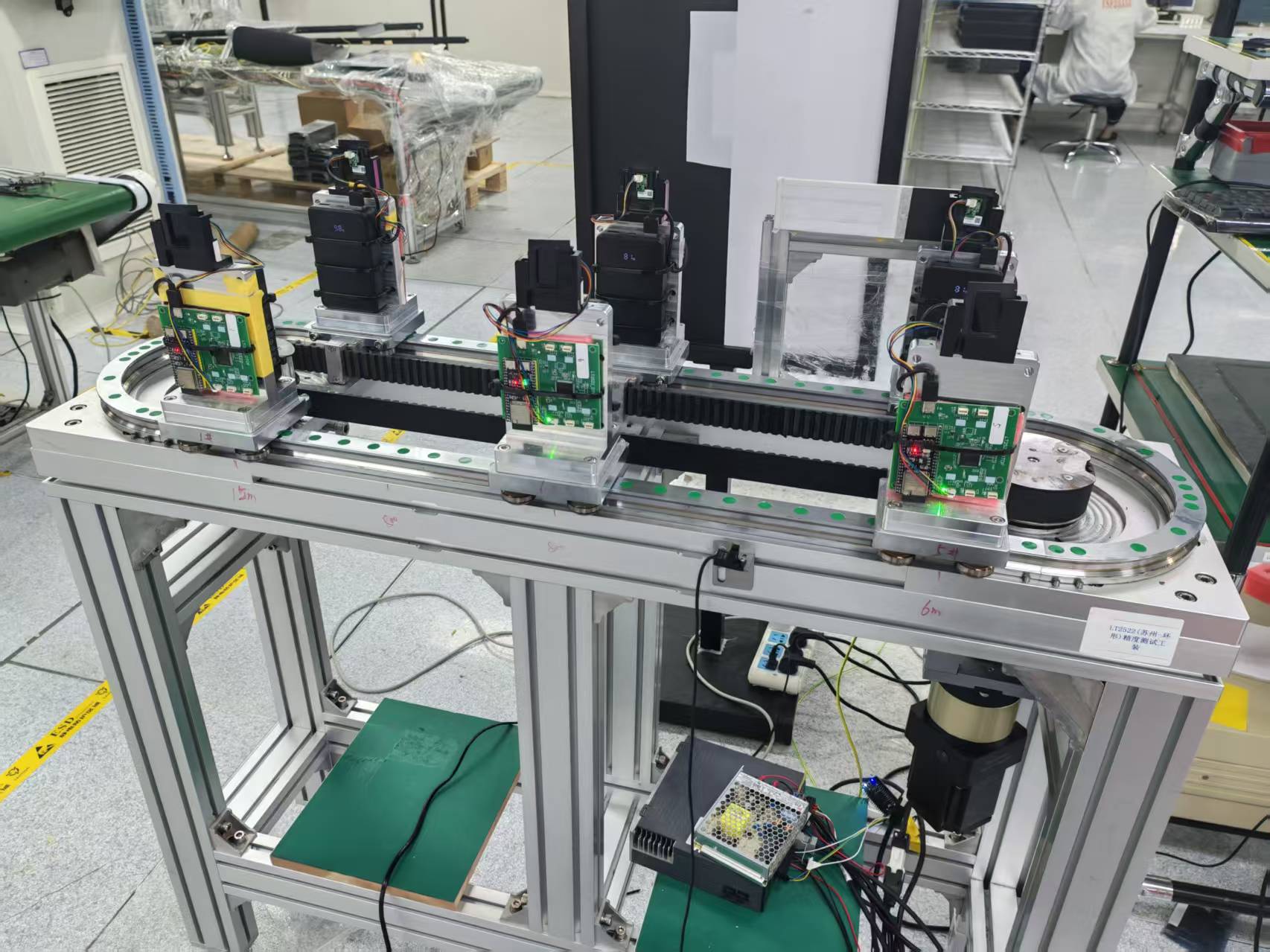
Unlike conventional belt conveyors, a Precision Circular Guide Rail Conveyor combines continuous product circulation with precise indexing, making it ideal for automated assembly, inspection, dispensing, laser processing, testing, and packaging. For OEM machine builders and automation system integrators, a custom-designed circular guide rail conveyor offers an efficient and scalable solution for high-performance manufacturing.
This guide explains how Precision Circular Guide Rail Conveyors work, their advantages, key applications, and why customized solutions provide greater long-term value.
A Precision Circular Guide Rail Conveyor is a closed-loop conveyor system that transports pallets or fixtures along a precision circular guide rail. Driven by a servo-controlled transmission system, each pallet stops accurately at predefined workstations, enabling synchronized automation processes.
Compared with standard conveyor systems, a precision circular guide rail conveyor offers:
These features make it an ideal platform for smart manufacturing.
The system uses a precision guide rail, drive chain or link mechanism, and servo motor to move pallets around a circular track.
A typical production cycle includes:
Because each station is synchronized through the control system, the conveyor maintains consistent cycle times and repeatable positioning.
The primary advantage of a Precision Circular Guide Rail Conveyor is its ability to stop pallets precisely at each workstation.
This enables:
High repeatability improves product quality and reduces production errors.
Servo-controlled indexing allows pallets to move quickly while maintaining smooth operation.
Benefits include:
This makes the system suitable for high-volume manufacturing.
A circular conveyor layout maximizes production capacity while minimizing floor space.
Compared with long linear conveyor systems, circular guide rail conveyors:
Precision Circular Guide Rail Conveyors integrate easily with:
This enables highly automated production lines with minimal manual intervention.
Designed for continuous industrial operation, these conveyors feature:
Proper engineering helps reduce maintenance while extending equipment life.
Suitable for:
High precision supports consistent product quality.
Used for:
Stable indexing improves process reliability.
Applications include:
Repeatable positioning ensures high manufacturing standards.
Battery assembly requires:
Circular guide rail conveyors improve production efficiency in battery manufacturing.
Ideal for:
Automation reduces labor while improving consistency.
| Feature | Precision Circular Guide Rail Conveyor | Traditional Belt Conveyor |
|---|---|---|
| Positioning Accuracy | Excellent | Moderate |
| Repeatability | Excellent | Limited |
| High-Speed Indexing | Yes | No |
| Automation Integration | Excellent | Basic |
| Multi-Station Assembly | Excellent | Limited |
| Space Utilization | High | Moderate |
For automated assembly and precision manufacturing, a circular guide rail conveyor provides clear performance advantages.
Every production line has unique process requirements.
A custom Precision Circular Guide Rail Conveyor can be configured according to:
Designed for specific product sizes.
Optimized for production flow.
Customized to fit available factory space.
Engineered for lightweight or heavy-duty applications.
Matched to production targets.
Integrated with robots, vision systems, sensors, and PLC controllers.
Customization improves production efficiency while supporting future expansion.
Before selecting a system, engineers should evaluate:
Determines pallet design and structural requirements.
Defines servo system and guide rail specifications.
Influences indexing speed and workstation layout.
Determines conveyor diameter and station arrangement.
Choose a system that allows additional workstations or upgraded automation.
Partnering with an experienced manufacturer ensures the conveyor is engineered for long-term performance.
The latest conveyor systems are incorporating advanced smart manufacturing technologies, including:
These innovations improve efficiency, reduce downtime, and provide greater production visibility.
An experienced manufacturer offers complete engineering support, including:
This collaborative approach minimizes project risk and helps ensure successful automation deployment.
A Precision Circular Guide Rail Conveyor is a highly efficient solution for manufacturers seeking accurate positioning, fast indexing, and seamless automation integration. Compared with traditional conveyor systems, it offers superior precision, higher throughput, better space utilization, and greater flexibility.
For OEM machine builders, automation integrators, and industrial manufacturers, investing in a custom Precision Circular Guide Rail Conveyor provides a scalable platform that supports today's demanding production requirements while preparing factories for the future of smart manufacturing.