A precision conveyor is a conveying system designed to move workpieces, components, or fixtures through a production process with controlled movement and repeatable positioning. It is commonly used in automated assembly, inspection, testing, electronics manufacturing, and other industrial applications where consistent workpiece handling is important.
Unlike a general-purpose conveyor used mainly for material transportation, a precision conveyor may incorporate dedicated carriers, locating fixtures, indexing mechanisms, sensors, and control systems to meet specific production requirements.
Depending on the application, a precision conveyor can use belts, chains, precision links, or other conveying mechanisms. The appropriate configuration depends on the workpiece, required positioning performance, payload, operating speed, production layout, and integration requirements.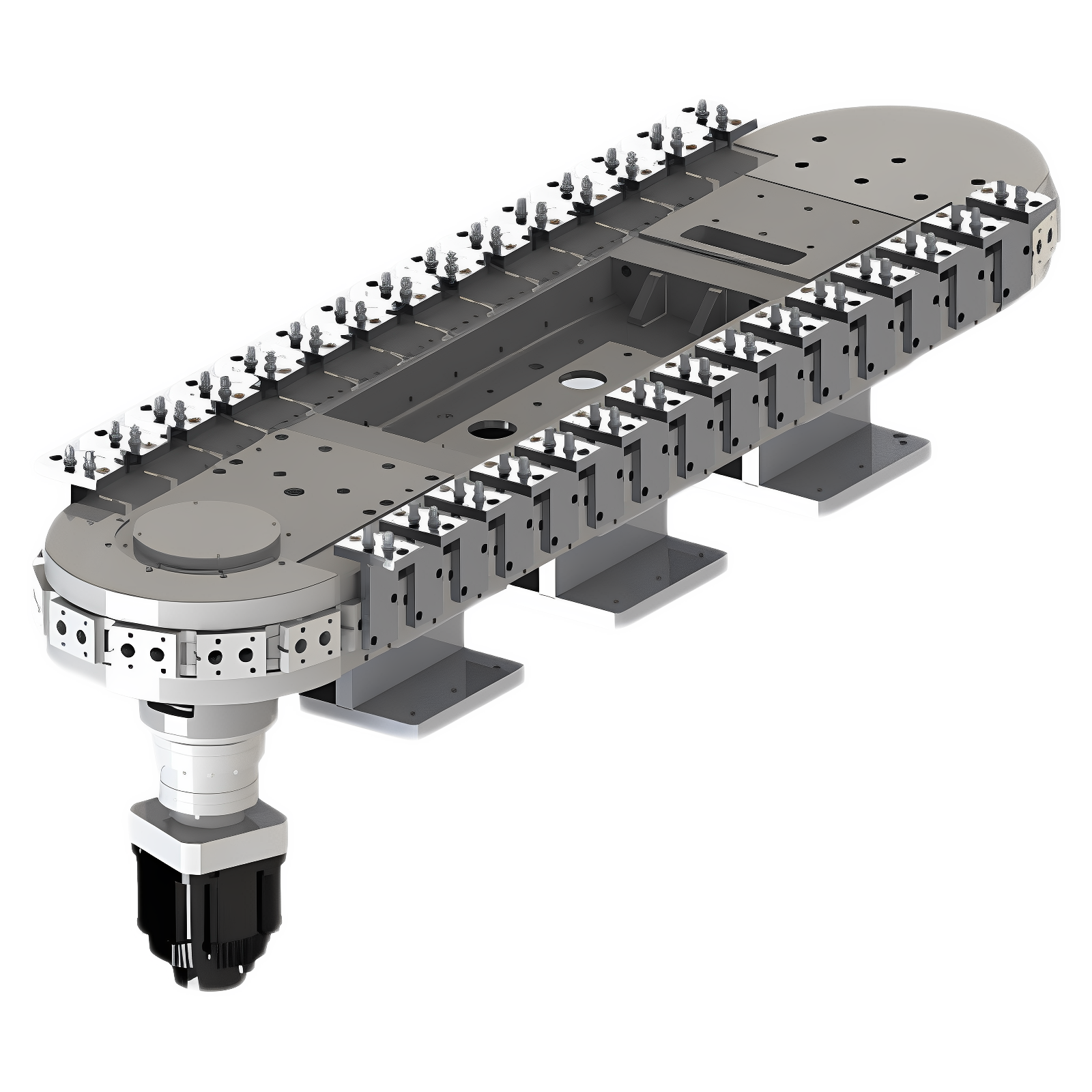
For OEM equipment manufacturers and automation integrators, a custom precision conveyor system can be designed around the actual production process rather than relying entirely on standard dimensions and configurations.
Repeatable workpiece positioning is important when products must arrive at defined locations for assembly, inspection, dispensing, fastening, or testing.
A precision conveyor can be designed with suitable carriers, mechanical stops, indexing drives, and secondary locating mechanisms to help position workpieces consistently at processing stations.
The achievable positioning performance depends on the conveyor structure, drive mechanism, carrier design, stopping method, and any additional positioning equipment. For applications with tight tolerances, transport accuracy and final station positioning should be evaluated separately.
Production equipment often has specific space constraints and station arrangements. A standard conveyor may not match the required working area or the distance between processing stations.
Custom precision conveyors can be configured according to:
Conveyor length and overall dimensions
Straight, closed-loop, or application-specific layouts
Station spacing and transfer positions
Workpiece carrier dimensions
Mounting holes and machine connection interfaces
Integration with upstream and downstream equipment
This flexibility helps OEM customers incorporate the conveyor into new machines or existing production lines with fewer mechanical modifications.
Different conveying mechanisms offer different advantages. The right choice depends on the production process and required performance.
|
Conveyor type |
Main characteristics |
Typical applications |
|---|---|---|
|
Precision link conveyor |
Suitable for controlled workpiece transfer and multi-station processes when properly configured |
Automated assembly, indexed production |
|
Precision chain conveyor |
Can support dedicated carriers and application-specific layouts |
Industrial assembly, component handling |
|
Belt conveyor |
Suitable for general transfer and continuous material movement |
Packaging, product transfer |
|
Circular or closed-loop conveyor |
Allows workpieces to circulate through multiple stations |
Compact assembly cells, multi-station automation |
|
Precision indexing conveyor |
Designed around defined movement and stopping sequences |
Assembly, inspection, automated testing |
The conveyor mechanism should be selected according to the required payload, cycle time, workpiece geometry, maintenance conditions, and positioning requirements.
The carrier is a key component in many precision conveyor systems. It supports the workpiece during transportation and provides a consistent interface with automated processing stations.
For custom applications, carrier design can include:
Dedicated workpiece fixtures
Custom carrier plates and mounting holes
Locating pins and reference surfaces
Interchangeable fixtures for different product models
Interfaces for robotic loading and unloading
Mounting features for inspection or assembly operations
Well-designed carriers can improve workpiece consistency and make the conveyor easier to integrate with other equipment.
Some manufacturing processes require continuous conveying, while others need workpieces to stop at specific locations for processing.
A precision conveyor can be configured for continuous movement, intermittent indexing, or another suitable motion sequence. For indexed applications, the drive and control system must be coordinated with the cycle time of each processing station.
Where more demanding positioning performance is required, an additional locating mechanism may be used to position the workpiece independently of the conveyor's transport accuracy.
Precision conveyors often operate as part of a larger automated production line.
Depending on the application, they may need to work with:
Industrial robots and PPU pick-and-place units
Automated assembly and fastening equipment
Machine vision inspection systems
Sensors and workpiece detection devices
Electric cylinders and linear motion modules
PLCs and production line control systems
Considering these interfaces during the design stage helps reduce installation adjustments and commissioning problems.
Precision conveyors are used in industries where workpieces must move through a defined process with consistent handling and positioning.
3.1 Automated Assembly Lines
Precision conveyors transfer workpieces between loading, assembly, fastening, testing, and unloading stations. Custom station spacing and carrier fixtures help match the conveyor to the product and manufacturing sequence.
3.2 Electronics Manufacturing
Electronics production may require consistent positioning during component assembly, soldering, inspection, and testing. A custom precision conveyor can be integrated with automated handling devices and station-specific tooling.
3.3 Inspection and Measurement Equipment
Precision conveyors can transfer workpieces to cameras, sensors, measurement systems, and functional testing stations. For applications with strict measurement tolerances, secondary locating devices may be needed to establish a consistent inspection position.
3.4 Automotive Component Production
Automated automotive component manufacturing often involves multiple processing steps and dedicated workpiece fixtures. A custom conveyor can be configured around the required payload, station count, cycle time, and machine layout.
3.5 Multi-Station and Closed-Loop Automation
Circular, oval, and other closed-loop conveyor configurations allow carriers to circulate through multiple stations. They can help organize compact production cells where several operations must be arranged around a common conveying path.
3.6 Packaging and Product Handling
Precision conveyors can transport products between filling, labeling, inspection, assembly, and packaging operations. The system should be selected according to product stability, throughput, cleaning requirements, and the need for repeatable positioning.
The main difference between a precision conveyor and a conventional conveyor is the application requirement. Precision systems place greater emphasis on controlled workpiece handling, carrier design, and repeatable positioning at processing stations.
|
Design consideration |
Precision conveyor |
Conventional conveyor |
|---|---|---|
|
Primary objective |
Controlled transfer and positioning |
General material transportation |
|
Workpiece carriers |
Often customized for the product |
May use standard belts, rollers, or containers |
|
Station indexing |
Can be designed around defined processing sequences |
Depends on drive and control configuration |
|
Positioning requirements |
Evaluated according to the application |
Often less demanding |
|
Automation integration |
Designed around specific machine interfaces |
Can range from simple to highly integrated |
|
Typical applications |
Assembly, inspection, testing, multi-station processing |
Bulk transfer, packaging, general handling |
A precision conveyor is not automatically necessary for every production line. If workpieces only need to move between locations without strict positioning requirements, a conventional conveyor may be more economical.
For OEM equipment manufacturers, a conveyor should be designed around the workpiece and production process rather than selected only by overall length or carrying capacity.
A custom precision conveyor system can be tailored to meet specific mechanical, operational, and integration requirements.
The size, weight, geometry, and reference surfaces of the workpiece influence carrier design. Custom fixtures can help locate the product and provide consistent interfaces for automated operations.
Define whether the process requires continuous movement, fixed indexing distances, or accurate positioning at individual stations. The required tolerance should be specified clearly so that the conveyor and any secondary locating mechanism can be designed appropriately.
The total load includes the workpiece, carrier, fixture, and other supported components. The drive mechanism, guides, and structure should be evaluated for the actual payload, speed, acceleration, and duty cycle.
The number of stations, distance between operations, and material flow determine the conveyor layout and overall length. Closed-loop systems may be suitable when several stations need to share a common conveying path.
The conveyor may need to integrate with robots, sensors, electric cylinders, PPU units, vision systems, and PLC controls. These interfaces should be considered early in the engineering process.
Temperature, dust, moisture, lubrication, cleaning procedures, and other environmental factors can affect material and component selection. Special conditions should be communicated to the manufacturer before the design is finalized.
Choosing a suitable precision conveyor manufacturer involves more than comparing prices and conveyor dimensions. The supplier should understand the production process and be able to evaluate the complete conveying application.
Before requesting a quotation, consider the following factors:
Application experience: Can the manufacturer assess your assembly, inspection, or material handling process?
Customization capability: Can the conveyor length, layout, carriers, and mounting interfaces be adapted to your equipment?
Positioning approach: Can the supplier explain how the required positioning performance will be achieved?
Drive and control options: Can the conveyor support the required movement sequence, cycle time, and automation interfaces?
Technical documentation: Can the manufacturer provide engineering drawings and interface dimensions?
Maintenance requirements: Are wear components, lubrication, inspection, and replacement procedures clearly defined?
Engineering communication: Can the supplier review application drawings and coordinate with your engineering team?
For a custom project, a machine layout and description of the production sequence are useful starting points for technical evaluation.
KNK Technology provides linear motion products and customized solutions for industrial automation. For OEM customers developing assembly machinery and automated production equipment, the suitable conveying configuration should be evaluated according to workpiece requirements, payload, station arrangement, motion sequence, and integration constraints.
Depending on the project, customers may explore precision chain conveying, circular conveyor systems, linear motion modules, and related automation components.
Visit the KNK Technology website to review the product range and discuss your application requirements with the engineering team.
When requesting a custom solution, provide the workpiece dimensions, carrier requirements, conveyor layout, cycle time, positioning tolerance, and automation interfaces. This information helps establish an appropriate technical direction before detailed design begins.