

T Series Elliptical Conveyor System
0.05mm repeat positioning accuracy with 1000mm/s speed. The T Series integrates high-strength, modular design for reliable, cost-effective precision conveyor systems.
View productAn oval belt conveyor system carries tooling around a closed loop and holds it at each station, so transfer and positioning happen in one compact frame. The T Series is built on a link-type indexing chain, a precision circular guide rail and a high-strength frame, and its modular selection means an automatic oval conveyor can be re-configured as the cell layout or tooling changes. This guide walks through the published specifications, the fit checks that decide whether a loop is the right topology, and the details worth settling before you request a quote.

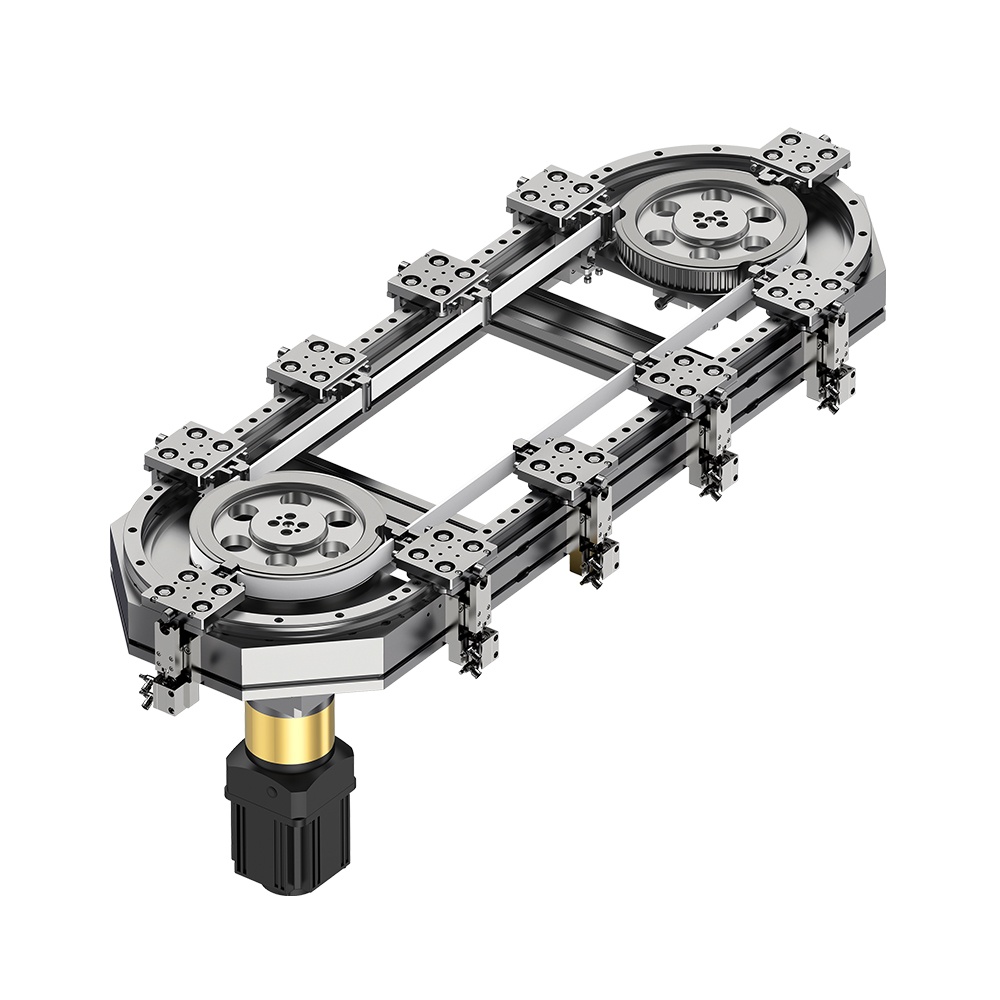
An oval belt conveyor system is a closed-loop transfer unit that moves tooling around an elliptical track and stops it at fixed stations, combining conveying with positioning in a single mechanism. The KNK T Series is specified at a 0.05 mm repeat positioning accuracy with no secondary positioning required, a maximum operating speed of 1000 mm/s and a cumulative load of 40 kg.

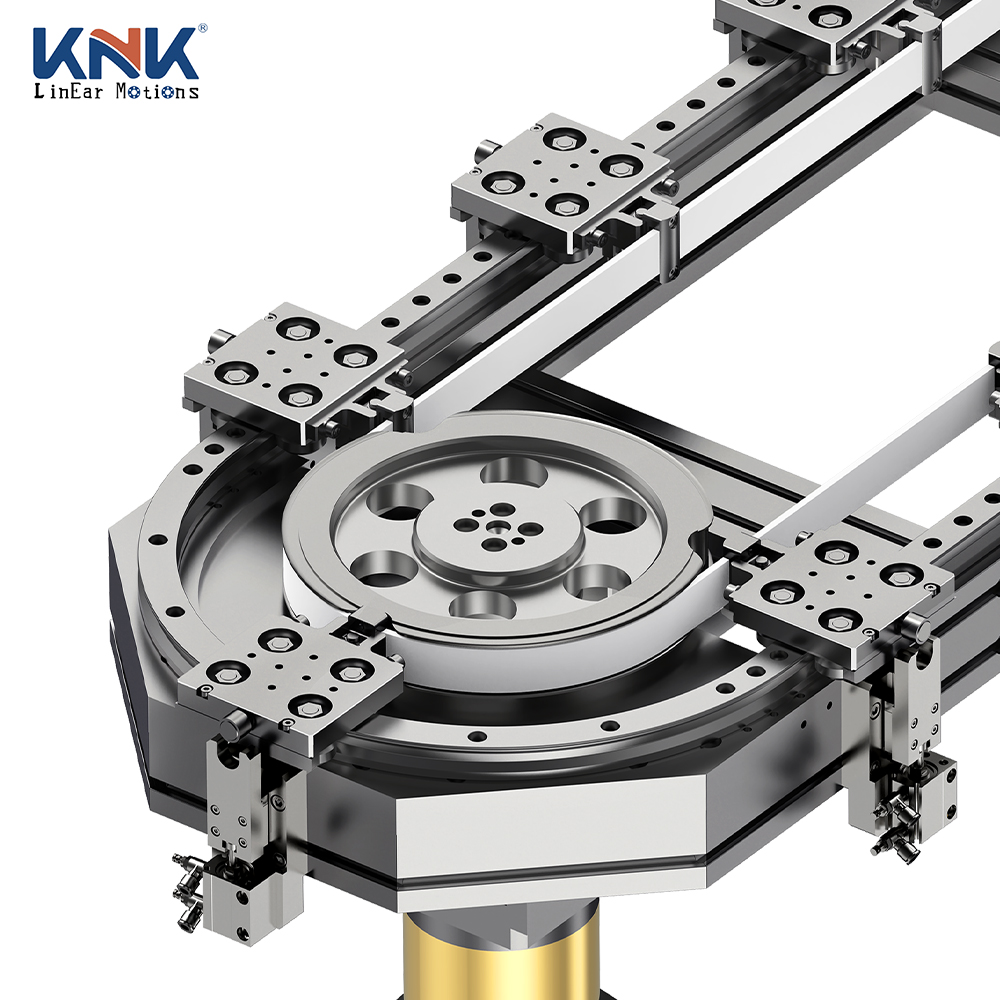
Four elements do the work: the frame defines the oval path, the indexing chain drives it, the circular guide rail keeps it on line, and the index stop provides the position.
A high-strength frame sets a continuous loop, so tooling returns to the first station without a separate return conveyor or operator carry-back.
The conveyor mechanism is a link-type indexing chain that advances the carriages in discrete steps rather than in continuous motion, which is what makes station-to-station handover repeatable.
A precision circular guide rail guides the carriages through the oval path, keeping the loop smooth and the geometry stable across long production runs.
Because conveying and positioning are integrated, the 0.05 mm repeat positioning accuracy is delivered by the index motion and no secondary positioning is required.
Every row below is taken from the current T Series data. The right-hand column translates each value into a decision you will actually make during cell design.
| Parameter | Published value | What it changes in your cell |
|---|---|---|
| Repeat positioning accuracy | 0.05 mm | Stations can be located by the index motion alone; no secondary positioning device is required at the stop. |
| Maximum operating speed | 1000 mm/s | Sets the shortest index time you can plan between stations and therefore the throughput ceiling of the loop. |
| Cumulative load | 40 kg | Budget total carried mass — fixture, tooling and workpiece — rather than the weight of a single part. |
| Frame construction | High-strength frame | Holds loop geometry under load, which is what protects the accuracy figure over a long production run. |
| Guide rail | Precision circular guide rail | Carries the carriages around the oval path; smooth guidance is what keeps indexed motion repeatable. |
| Conveyor mechanism | Link-type indexing chain | Suits cells that need discrete station stops rather than continuous or accumulating transfer. |
| Function | Conveying + positioning combined | Removes a station from the layout, which is where the compact footprint and lower system complexity come from. |
| Material & service life | High-strength materials, good precision retention, long service life | Reduces replacement cycles and keeps accuracy from drifting as the line ages. |
| Maintenance posture | Maintenance-free operation | Fewer planned stops for service, which feeds directly into downtime and total cost of ownership. |
| Design approach | Modular selection | High design efficiency up front and fast configuration change when the process or layout is revised. |
These items are not fixed figures on the product page — they are settled when a configuration is specified:
Send these requirements together and the configuration can be quoted as one package — Get The Latest Quote on the T Series product page.
Five checks decide fit. If a check lands on the right-hand column, the constraint is the question to raise, not the product.
Fits when: fixture, tooling and part weight together stay inside the 40 kg cumulative load.
Check first when: one station handles a heavier sub-assembly — confirm the loading assumption before quoting.
Fits when: your required index speed sits below the 1000 mm/s maximum operating speed.
Check first when: the cell needs continuous, non-indexed transfer — that is a different conveyor logic.
Fits when: 0.05 mm repeat positioning covers your assembly tolerance and you want to delete a secondary locator.
Check first when: a station needs positioning beyond that figure — discuss the process step during configuration.
Fits when: you can dedicate a closed loop; the oval returns tooling without a separate return line, which is where the compact footprint comes from.
Check first when: the layout is a single straight run — a linear module is the more direct fit.
Fits when: tooling or station count is likely to change; modular selection supports fast configuration change.
Check first when: the line is fixed for years — keep the modular advantage in view, but weight other criteria higher.
Fits when: the line must run with minimal planned service; the system is designed for maintenance-free operation.
Check first when: your site requires a scheduled service contract — raise it at the quote stage.
A loop only pays off if it drops into the cell you already have. These four points cover what the T Series is designed to do in that role.
Keep adjacent product options together for a faster catalog comparison.
0.05mm repeat positioning accuracy with 1000mm/s speed. The T Series integrates high-strength, modular design for reliable, cost-effective precision conveyor systems.
View product
Ensure stable automation with the KS series precision link conveyor. Featuring 1000mm/s speed and 40kg capacity, this robust conveyor link optimizes assembly.
View product
Featuring a rigid architecture, this indexing conveyor system delivers 0.05mm repeat accuracy at 1000mm/s for high-precision, automated industrial assembly.
View productreview the product details, images, and specifications presented on the official product page.
use the application and use-case information published on the official product page.
confirm the specifications and options listed for the exact product variant before placing an order.
check the official product page or ask the supplier about options shown for the selected product.
use the official contact or inquiry path provided on the site.
include the product page, intended use, required quantity, and any specifications you need the supplier to review.