Precision Link Conveyor Manufacturer: Custom Solutions for Industrial Automation
A precision link conveyor is a conveying system designed to move workpieces, fixtures, or carriers between multiple stations in a controlled and repeatable manner. It is commonly used in automated assembly lines, inspection equipment, and manufacturing systems where workpieces need to be transported through a defined production sequence.
Unlike a general-purpose material handling conveyor, a precision link conveyor is often designed around specific station spacing, carrier dimensions, workpiece requirements, and machine interfaces. Depending on the design, the system may use precision chains or linked conveying components, dedicated fixtures, positioning mechanisms, and integrated controls.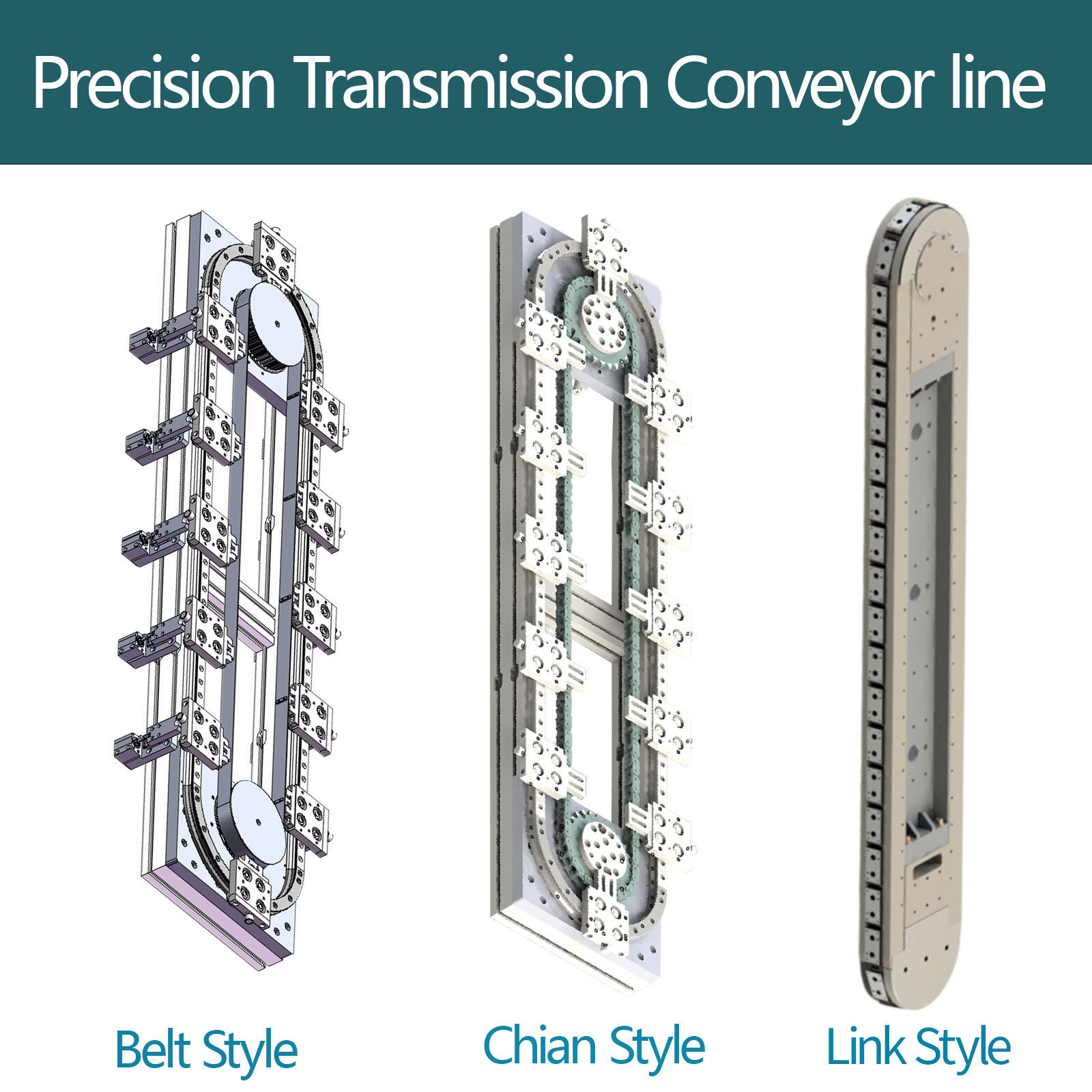
For OEM equipment manufacturers and automation integrators, selecting the right precision link conveyor manufacturer is important when the conveyor must fit a customized machine layout, support specialized workpieces, and coordinate with multiple production stations.
A custom precision link conveyor system can be developed according to required conveyor length, carrier design, station arrangement, payload, operating speed, and positioning requirements.
Many automated manufacturing processes require workpieces to arrive at a station in a consistent position. Precision link conveyor systems can be designed with suitable carriers, locating features, and station positioning mechanisms to support repeatable workpiece placement.
This is useful for assembly, inspection, dispensing, fastening, and other operations where workpiece alignment affects process quality.
The actual positioning accuracy depends on the conveyor structure, chain or link design, carrier fixtures, stopping or indexing mechanism, and any secondary positioning device. For applications with demanding tolerances, the positioning requirements should be defined separately from the conveyor's general transport accuracy.
Different production lines have different installation constraints. A standard conveyor may not match the required station spacing, machine dimensions, or production flow.
A custom precision link conveyor can be configured for:
Conveyor length and overall dimensions
Straight-line or application-specific layouts
Station spacing and workpiece transfer positions
Carrier dimensions and fixture interfaces
Machine mounting and connection points
Integration with upstream and downstream equipment
For OEM projects, custom dimensions help align the conveyor with the complete production line rather than requiring the machine layout to follow a standard conveyor size.
Precision link conveyors are suitable for production processes that require workpieces to pass through multiple stations in a defined sequence.
For example, a workpiece may move through loading, assembly, fastening, inspection, and unloading stations. The conveyor design can be coordinated with the station cycle times and the operating logic of the production equipment.
Depending on the system architecture, the conveyor may operate continuously or use intermittent indexing, with workpieces stopping at designated processing positions.
The carrier is an important part of a precision link conveyor system because it holds and locates the workpiece during transportation and processing.
For customized equipment, carriers may be designed according to the shape, size, weight, and handling requirements of the product.
Customization options can include:
Dedicated workpiece fixtures
Carrier plates with custom mounting holes
Locating pins and reference surfaces
Interchangeable fixtures for multiple product models
Interfaces for automated loading and unloading
Features compatible with inspection or assembly tools
A properly designed carrier helps improve workpiece consistency and supports smoother integration with automated stations.
Some manufacturing applications require workpieces to move continuously, while others require accurate stops at specific processing positions.
A precision link conveyor can be designed around the required operating method. An indexing configuration may coordinate conveyor movement with station operations, while a continuous conveying configuration may suit processes that do not require the same stopping sequence.
Drive selection, control logic, chain characteristics, carrier design, and station positioning should all be considered when determining the most suitable configuration.
A precision link conveyor often operates as part of a larger automated production system rather than as an independent conveying device.
Depending on the application, it may need to interface with:
Industrial robots and pick-and-place units
Assembly and fastening machines
Machine vision inspection systems
Sensors and workpiece detection devices
Automatic loading and unloading mechanisms
PLCs and production line control systems
Planning these interfaces during the design stage can help reduce integration issues during installation and commissioning.
Precision link conveyors are commonly used in automated manufacturing processes where workpieces need to move through several stations in a controlled sequence.
3.1 Automated Assembly Lines
A precision link conveyor can transport components between loading, assembly, fastening, testing, and unloading stations. Custom carrier fixtures and station spacing help manufacturers adapt the conveyor to different products and production processes.
3.2 Electronics Manufacturing
Electronic components and assemblies often require consistent positioning during assembly and inspection. Precision link conveyors can be integrated with automated screwdriving, dispensing, component placement, and testing equipment.
3.3 Automotive Component Production
Automotive component assembly may involve multiple operations performed in a fixed sequence. A custom conveyor system can be configured for the required workpiece dimensions, tooling, payload, station count, and production cycle.
3.4 Automated Inspection and Testing
Precision link conveyors can transfer products to inspection cameras, measurement equipment, and functional testing stations. Where tighter positioning tolerances are required, dedicated locating mechanisms may be added to position the workpiece independently of the conveyor's transport accuracy.
3.5 Medical Device and Instrument Assembly
Specialized assembly equipment may require repeatable workpiece handling, dedicated fixtures, and coordinated multi-station processing. Custom conveyor configurations can be developed around the product geometry and manufacturing workflow, with materials and surface treatments selected for the operating environment.
3.6 Robotic Pick-and-Place Automation
A precision link conveyor can coordinate workpiece movement with robotic arms and pick-and-place units. The system layout, indexing sequence, and carrier design should be planned together to support reliable transfers and the required production cycle.
A conventional belt conveyor is often suitable for general material transportation. A precision link conveyor is worth considering when the process requires dedicated carriers, controlled indexing, or repeatable positioning at multiple workstations.
|
Design consideration |
Precision link conveyor |
Conventional belt conveyor |
|---|---|---|
|
General material transport |
Suitable |
Suitable |
|
Indexed movement between stations |
Suitable when configured for indexing |
Depends on drive and control design |
|
Dedicated workpiece carriers |
Can be designed for the application |
Depends on conveyor and fixture design |
|
Multi-station assembly |
Well suited |
Suitable for some processes |
|
Repeatable positioning |
May require a dedicated positioning mechanism |
May require stops or external locating devices |
|
Custom machine integration |
Can be designed around station and tooling requirements |
Also customizable, depending on design |
|
Best suited for |
Controlled transfer and multi-station automation |
General conveying and material movement |
The choice should be based on the required cycle time, payload, workpiece geometry, positioning tolerance, maintenance needs, and total system cost. A precision link conveyor is not automatically the best option for every production line.
For OEM equipment manufacturers, the conveyor should be designed around the production process rather than selected by length or load capacity alone.
A custom precision link conveyor manufacturer should evaluate the following requirements during the engineering stage.
The size, weight, shape, and reference surfaces of the workpiece affect the carrier design. Custom fixtures can help locate products and provide mounting points for tools or inspection equipment.
The required number of processing stations and the distance between them influence conveyor length, layout, and indexing requirements. The design should account for the time required for both conveying and processing.
The total load includes the workpiece, carrier, fixtures, and any additional components supported by the conveyor. Link design, guides, frame rigidity, and drive sizing should be evaluated against the actual load and operating cycle.
Some applications require fixed indexing distances, while others need adjustable or programmable movement. The drive and control system should be selected according to the required motion sequence and cycle time.
The conveyor may need to work with robots, sensors, machine vision, pneumatic tools, electric actuators, and PLC-based controls. Defining these interfaces before manufacturing can simplify integration and commissioning.
Temperature, dust, lubrication, cleaning procedures, and other environmental factors can affect material and component selection. Special requirements should be discussed with the manufacturer before the design is finalized.
Choosing a suitable precision link conveyor manufacturer involves evaluating both the conveyor design and the supplier's ability to support a customized OEM project.
Consider these factors before requesting a quotation:
Application experience: Can the supplier assess your specific assembly or material handling process?
Customization capability: Can the conveyor length, station spacing, carriers, mounting interfaces, and drive arrangement be adapted to your machine?
Positioning requirements: Can the supplier explain how transport accuracy and station positioning will be achieved?
Drive and control options: Can the system work with the required motor, indexing mechanism, PLC, and other automation components?
Technical documentation: Can the supplier provide drawings, interface dimensions, and relevant technical specifications?
Maintenance requirements: Are lubrication, wear components, inspection intervals, and replacement procedures clearly defined?
Project coordination: Can the manufacturer review machine layouts and coordinate with your engineering team during the design stage?
For custom projects, it is useful to share a layout drawing and a description of the production process before selecting the final configuration.
To help a manufacturer assess your project efficiently, prepare the following information where available:
Workpiece dimensions and weight
Carrier or fixture requirements
Conveyor length and installation dimensions
Number of stations and station spacing
Required production rate or cycle time
Required indexing distance and positioning tolerance
Horizontal, vertical, or other installation configuration
Motor, controller, sensor, and automation interfaces
Operating environment and maintenance requirements
Drawings or a layout of the existing or planned equipment
These details help establish whether a standard configuration can meet the requirements or whether a more extensively customized conveyor system is needed.
KNK Technology provides linear motion products and customized solutions for industrial automation. For OEM customers developing assembly machinery and automated production equipment, the appropriate conveying solution should be evaluated according to the actual workpiece, station layout, load, motion sequence, and integration requirements.
Depending on the project, customers can explore KNK's linear motion product range and discuss their application with the engineering team.
When requesting a solution, provide the intended process, conveyor layout, required positioning performance, and carrier details. This allows the technical team to assess the application before recommending a configuration.